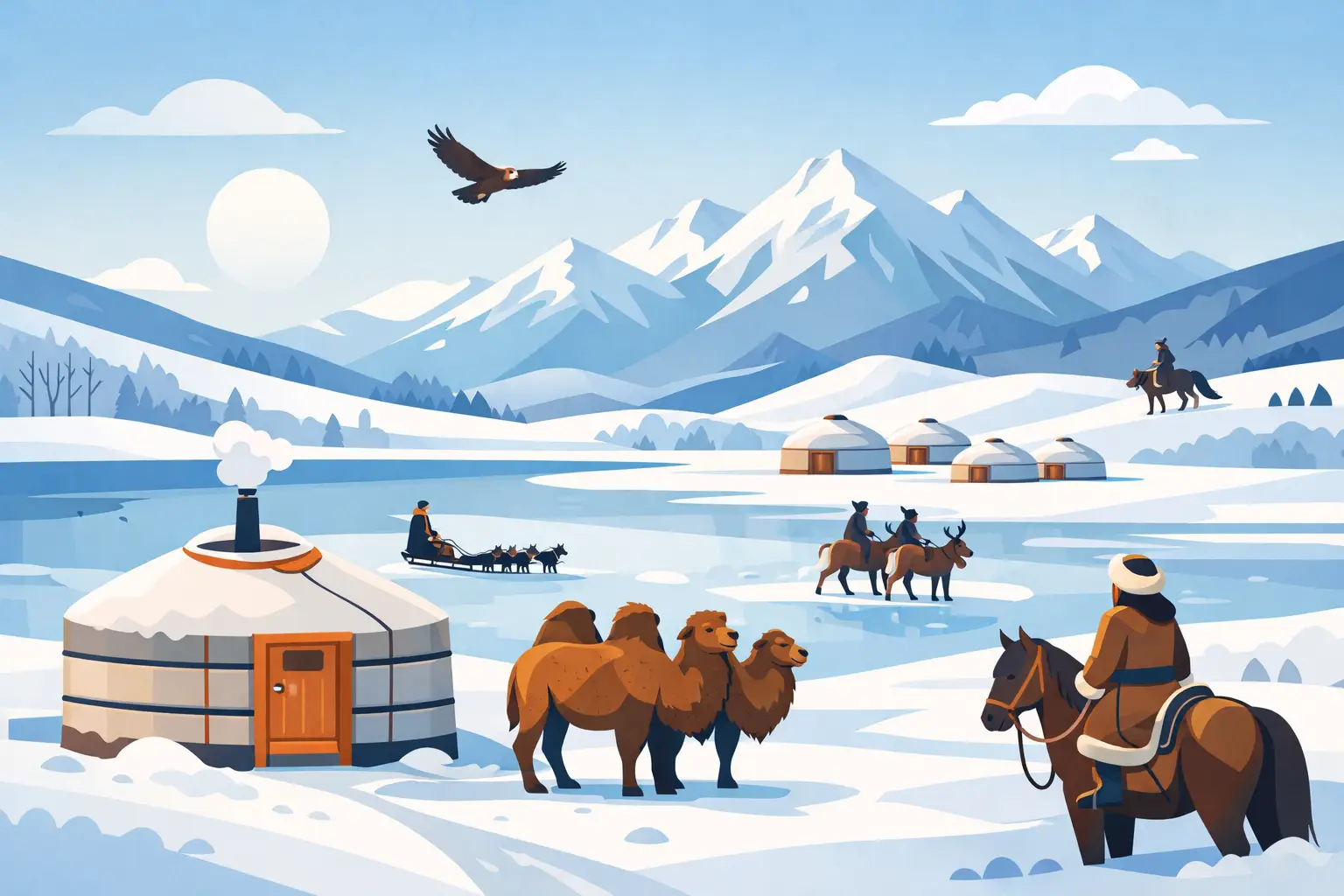
Winter in Mongolia is not a softened version of summer travel. It is a season of blue-shadowed steppe, smoke rising from ger chimneys, horses moving across frozen valleys, and an astonishingly clear Eternal Blue Sky. For travelers considering Mongolia winter tours 2027, the reward is a closer view of daily life in the nomadic heartland - provided the journey is planned around real cold, long distances, and changing road conditions.
This is a trip for travelers who value atmosphere over ticking off landmarks. A well-designed winter journey can be deeply comfortable and culturally rich, but comfort in Mongolia means warm gers, dependable vehicles, sensible pacing, and guides who know when weather requires a change of plan.
What Mongolia Winter Tours 2027 Are Really Like
Mongolia's winter generally runs from November through March, with the most severe cold often arriving from December to February. Temperatures can fall well below 0°F, especially overnight and in open country. In northern and central regions, -4°F to -22°F is possible during cold periods, while temperatures can drop further in exposed valleys. Wind changes the experience quickly.
That does not mean travelers spend every day battling the elements. Winter itineraries are built differently from summer expeditions. Outdoor visits are purposeful and paced: a walk through a frozen landscape, time with a host family, a horse or camel encounter where appropriate, then a return to a heated ger, lodge, or hotel. The contrast is part of the season's appeal.
The right itinerary depends on your tolerance for cold and your reason for traveling. Photographers may welcome the low sun, crystalline air, and textured winter light. Culturally curious travelers may be drawn to quieter time with nomadic families, when household routines center on livestock care, fuel, food, and hospitality. Families and private groups often prefer routes with fewer long driving days and more reliable indoor stops.
Choosing the Right Winter Region
Winter is not one uniform condition across Mongolia. Route design matters more than a simple list of destinations.
Central Mongolia and the steppe
Central Mongolia can be an excellent introduction to winter travel. Its broad valleys, rock formations, and ger districts offer a strong sense of open space without requiring the most remote logistics. It is often a good choice for travelers who want cultural encounters and winter scenery while keeping drives manageable from Ulaanbaatar.
Road surfaces may be snow-covered or icy, and winter daylight is limited. A realistic itinerary avoids treating every transfer as a scenic detour. In this season, a shorter route with time to settle into each place is usually more rewarding than trying to cross half the country.
The Gobi in winter
The Gobi Desert is cold in winter, not warm. Its advantage is often dryness and vast, uncluttered landscapes rather than mild weather. Snow can transform the dunes, cliffs, and plains, creating unusual photographic conditions and a powerful feeling of solitude.
The trade-off is exposure. Strong winds can make a modest temperature feel much colder, and some seasonal ger camps do not operate in winter. Accommodation must be confirmed carefully, with appropriate heating, insulation, and meal arrangements. A private journey can be particularly useful here because the route can be adjusted for weather, interests, and the comfort level of the group.
Frozen lakes and northern landscapes
Northern Mongolia offers some of the country's most dramatic winter scenery, including frozen lakes, forested valleys, and snow-covered mountains. These journeys require more resilience, more travel time, and greater flexibility than a central Mongolia route. Conditions on ice, winter roads, and domestic flight schedules should never be assumed in advance.
A visit to Khuvsgul Lake in winter can be memorable, but it should be planned with close attention to local conditions. The lake, nearby communities, and surrounding taiga feel far removed from city life, yet this is not a place to rush through on a tight schedule.
Western Mongolia and the Altai
The Altai Mountains offer a grander, more remote winter expedition. Travelers interested in Kazakh culture, winter eagle-hunting traditions, and mountain photography may find this region compelling. However, the famous autumn eagle festivals are not winter events, and an authentic winter journey should not be marketed as a festival substitute.
Instead, the focus is on the landscape and on respectful, pre-arranged visits with local families where appropriate. Harsh weather, long road distances, and limited infrastructure make experienced local planning essential.
Accommodation, Warmth, and Daily Comfort
A winter ger stay can be genuinely inviting, but expectations should be realistic. Traditional gers are heated by a stove, often fueled with coal, wood, or dried animal dung depending on the location. The area near the stove may become very warm while the edges of the ger stay cool. Temperatures also fall after the fire is allowed to burn down overnight.
Hotels in Ulaanbaatar and established provincial centers offer more conventional comfort, though heating and hot-water consistency can vary outside the capital. In the countryside, the quality of a winter stay comes down to preparation: good bedding, a reliable heat source, filling food, clean water arrangements, and a host team accustomed to the season.
Ask direct questions before booking. Will the ger be heated overnight? Is there an indoor toilet or a separate outdoor facility? How long are the daily drives? What happens if snow, wind, or road closures require a route change? Clear answers are more valuable than vague promises of adventure.
What to Pack for Mongolia in Winter
Winter packing is about a layering system, not a single enormous coat. Your outer layer should block wind, while the layers underneath should hold warmth and manage moisture. Cotton is a poor choice for the layers next to your skin because it stays damp when you sweat.
Bring insulated, waterproof boots with room for thick socks, plus traction suitable for ice. Warm mittens are usually more effective than gloves, though thin liner gloves help with cameras and phones. A hat that covers the ears, a neck gaiter or scarf, thermal base layers, insulated pants, sunglasses, lip balm, and moisturizer are all practical necessities.
Camera batteries drain quickly in severe cold. Carry spare batteries close to your body and place your camera in a protective bag before moving it from cold air into a heated room, which helps reduce condensation. A phone may also lose charge faster than expected, so a power bank belongs in an inner pocket.
Cultural Encounters Need Time and Respect
Winter hospitality is one of the most meaningful reasons to travel at this time. A family may welcome guests into a warm ger with salty milk tea, dairy foods, or a substantial meal. Accepting what is offered with appreciation matters, even if unfamiliar flavors are new to you.
A guide can help with the small points of ger etiquette: avoid stepping on the threshold, do not lean against support poles, and wait for guidance on where to sit. Ask before photographing people, children, private household spaces, or religious objects. In winter especially, hosts have work to do. A respectful visit fits around their day rather than interrupting it.
Responsible travel also means understanding that nomadic households are not staged attractions. Payment arrangements, introductions, and timing should be handled fairly through an experienced local operator, with the family's comfort and consent at the center.
Transport and Flexibility Matter More Than Ambition
Winter travel in Mongolia relies on capable drivers, well-maintained vehicles, warm clothing kept accessible inside the car, and conservative daily timing. Outside major towns, roads may be unpaved, snow-covered, or simply tracks across open land. A four-wheel-drive vehicle helps, but it cannot make poor weather irrelevant.
Domestic flights can save time on longer routes, yet winter weather may affect schedules. For that reason, international departures should not be scheduled immediately after an interior flight or a remote overland transfer. Build a buffer night in Ulaanbaatar at the end of the trip.
From our experience operating tours in Mongolia, the strongest winter itineraries have room to adapt. That may mean leaving earlier to use daylight, replacing a long drive with a local activity, or changing the order of overnight stops. Flexibility is not a compromise on quality. It is what makes a winter journey safer, calmer, and more enjoyable.
Is a Winter Journey Right for You?
Mongolia in winter suits travelers who can embrace a degree of unpredictability and who do not need every day to follow a rigid schedule. It is less suited to anyone uncomfortable with basic rural facilities, extended driving, or sustained cold. A tailor-made private journey can soften many logistical challenges, while a small group can offer companionship and shared confidence in remote places.
For 2027, begin planning early if you have fixed dates, a photography focus, particular accommodation preferences, or a private group. The best route is not necessarily the most remote one. It is the route that gives you enough time to feel the stillness of the steppe, meet people with care, and return each evening knowing the practical details have been considered.
A Mongolian winter does not ask you to conquer it. Travel with patience, dress for the conditions, and let the season set the pace. That is when the cold becomes part of the story rather than an obstacle to it.