Mongolia Travel Blog
How to Meet Eagle Hunters in Western Mongolia
Learn how to meet eagle hunters in western Mongolia, choose festival or family visits, travel respectfully, and plan around Altai weather and distance well.
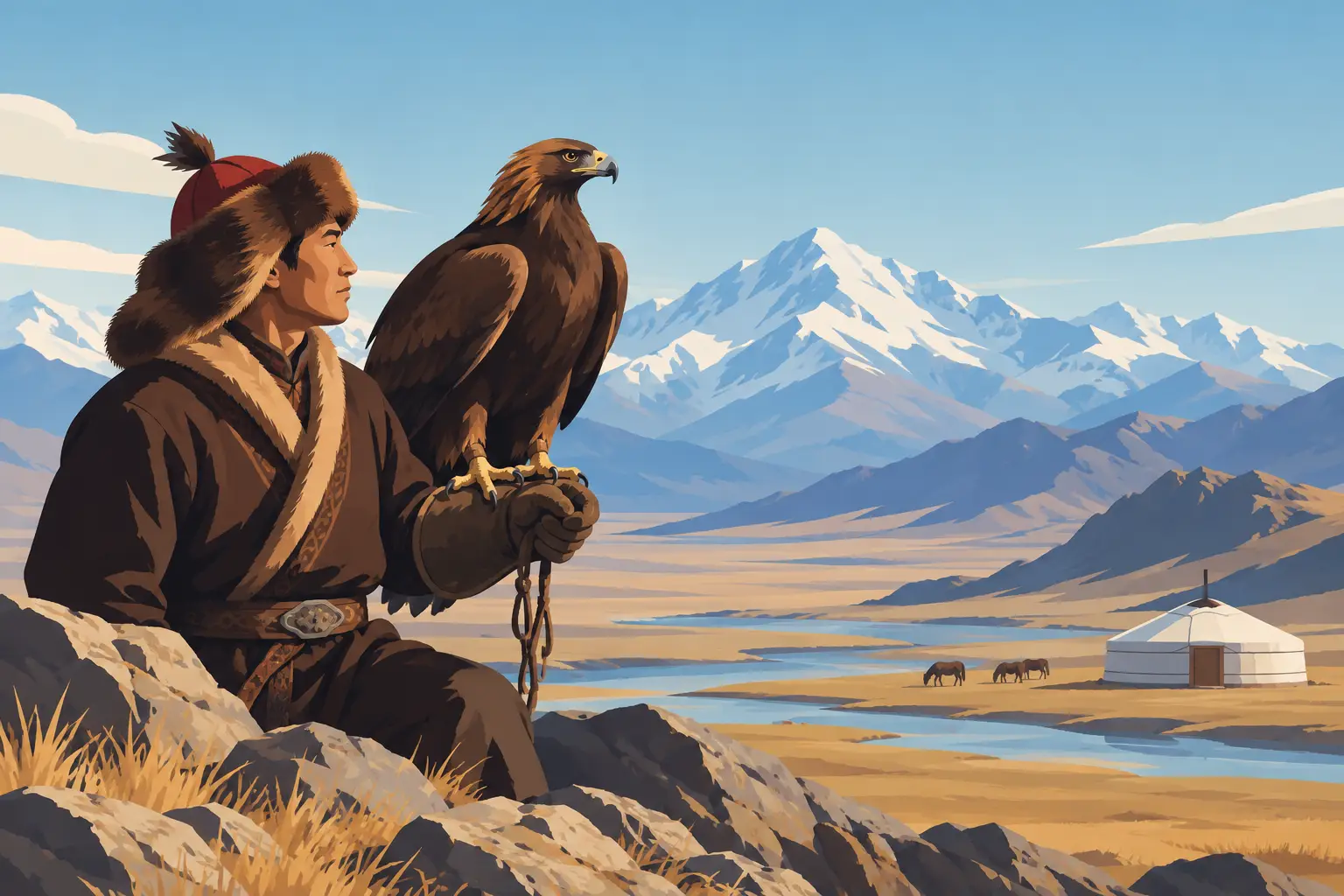
A golden eagle does not arrive on cue. It may be resting on a wooden perch outside a ger, riding quietly on an eagle hunter’s arm, or absent altogether while its owner tends animals and family work. That is the first thing to understand when researching how to meet eagle hunters in Mongolia: the most meaningful encounters are built around real lives, not a performance timetable.
Eagle hunting is practiced by Kazakh families in western Mongolia, particularly in Bayan-Ulgii Province and the broad valleys beneath the Altai Mountains. The region is extraordinary - open steppe, snow-bright summits, river valleys, and the familiar silhouette of a hunter on horseback with a golden eagle. It is also remote, weather-dependent, and deeply personal. Good planning helps turn a hoped-for photograph or conversation into a respectful cultural experience.
Where to Meet Eagle Hunters in Mongolia
Bayan-Ulgii is the center of eagle hunter travel in Mongolia. Ulgii, the provincial capital, is the practical arrival point, while eagle hunters and their families live across surrounding districts and rural valleys. Sagsai is especially associated with eagle hunting families and is a popular base for travelers seeking a more intimate experience beyond the large festival setting.
The distances here are substantial even when they look modest on a map. Travel from Ulgii into the countryside often follows unpaved tracks, with conditions changing after rain, snow, or river crossings. A capable vehicle and an experienced local driver matter, particularly in spring and autumn when the weather can turn quickly. Private journeys offer more flexibility for visiting a family in a quieter valley, while small-group departures can work well for travelers who want shared logistics and festival energy.
It is worth knowing that not every Kazakh herding family keeps an eagle, and not every eagle hunter is available to receive visitors on a given day. Household responsibilities, livestock movements, school schedules, weather, and hunting preparation shape daily life. A local guide who knows the region can make arrangements with care rather than simply arriving unannounced.
Choose a Festival or a Family Visit
There are two very different ways to meet eagle hunters, and the best choice depends on what you hope to take away from the experience.
Eagle festivals: a vivid first encounter
The Golden Eagle Festival and the Sagsai Eagle Festival bring hunters, eagles, horses, families, and spectators together in one dramatic setting. They are excellent for travelers with limited time, photographers seeking action, and anyone who wants to see a range of traditional clothing, eagle-handling skills, and horseback events in a single visit.
Festivals are visually powerful. Hunters in fur-trimmed dels gather against the Altai landscape, while birds are released from high ground and called back to their owners. Yet a festival is also busy. Expect crowds around key events, changing light, dust or cold, and a program that may move according to local conditions. It is a celebration, not a controlled studio shoot.
If you are traveling primarily for photography, arrive with realistic expectations. Long lenses are useful for riding and eagle-flight events, while a wider lens helps tell the larger story of the crowd, mountains, horses, and camp life. Cold temperatures can drain batteries quickly, so carry spares close to your body.
Family visits: slower and more personal
A visit to an eagle hunter’s home can offer a quieter view of life in western Mongolia. You may share milk tea and homemade food, see the eagle’s perch and equipment, watch animals being tended, or hear - through an interpreter - how a family balances herding traditions with modern life. The conversation may be as memorable as any eagle portrait.
These visits should never be treated as access to a private household on demand. Arrange them through a Mongolia-based operator or guide with genuine local relationships, allow enough time for the visit, and accept that the day may not follow a fixed script. When a family welcomes you into a ger, you are a guest first and a traveler second.
For many people, the best itinerary combines both approaches: the energy of a festival and a separate rural visit with an eagle hunter family. This creates space to understand the tradition beyond its most public moments.
When Is the Best Time to Visit?
Autumn is the classic season for eagle hunter travel, when festival gatherings are often held and the Altai landscape begins to take on its winter colors. Days can be bright and crisp, but mornings and evenings may be sharply cold. Snow is possible, and wind is a constant consideration on exposed plains.
Winter offers a more demanding but striking experience. The landscapes become austere and luminous, and eagle hunting is traditionally associated with the colder months. However, winter travel in western Mongolia requires a serious approach to clothing, vehicles, heating, and contingency planning. It suits travelers comfortable with remote conditions and short daylight hours rather than those seeking an easy sightseeing trip.
Late spring and summer can be rewarding for broad Altai journeys, horse riding, and family stays, with greener valleys and milder daytime temperatures. However, travelers should not assume that eagle hunting demonstrations or festival activities will be available. Eagles and their owners have their own seasonal rhythms, and a respectful itinerary works around them.
Cultural Etiquette That Makes a Difference
A warm welcome in a ger is often accompanied by food or tea. Accepting at least a small amount when you can is a simple sign of appreciation. If dietary needs make this difficult, explain them politely through your guide rather than refusing abruptly.
Always ask before photographing people, interiors, personal belongings, or the eagle. This matters even when a family has hosted visitors before. A camera can create distance if it appears before a greeting. Spend a little time talking, observing, and listening before raising it.
Avoid handling an eagle unless its owner specifically invites you and your guide confirms that it is appropriate. Golden eagles are powerful working birds, not props. The hunter is responsible for the bird’s welfare and will decide what is safe. The same principle applies to horses, livestock, hunting equipment, and ceremonial clothing.
Gifts are not required, and cash should not be offered in a way that feels transactional or uncomfortable. If you wish to bring something, discuss it with your local guide in advance. Practical, thoughtful choices are usually better than random souvenirs, but an arranged visit should already include fair compensation for the host family’s time and hospitality.
Plan for the Realities of the Altai
Western Mongolia rewards patience. Domestic flight schedules can be affected by weather, road travel can take longer than expected, and a distant mountain valley may be accessible only by rough track. Build buffer time into an itinerary, especially if you are connecting to an international flight from Ulaanbaatar.
Accommodation ranges from simple local hotels in Ulgii to ger camps and hosted family stays in the countryside. Comfort can be arranged at different levels, but remote travel still means occasional limits on hot water, electricity, Wi-Fi, and room facilities. The trade-off is access to landscapes and communities far beyond the usual route.
Pack for layers rather than relying on one heavy coat. A windproof outer shell, insulated jacket, warm hat, gloves, sun protection, sturdy footwear, and a small daypack are useful in almost every season. In autumn and winter, warm boots and hand protection are particularly important because much of the experience happens outdoors.
Language is another practical consideration. Kazakh is widely spoken in the eagle hunter communities of Bayan-Ulgii, while Mongolian is also used. An interpreter does more than translate words. A good guide explains context, helps with etiquette, and ensures that questions about hunting, family life, religion, and tradition are asked with sensitivity.
Travel Responsibly Around Eagle Hunting
Eagle hunting carries deep cultural meaning, but it also raises questions for thoughtful travelers. Do not assume that every encounter explains the entire tradition, and do not pressure a family to stage activity solely for an image. Ask your guide how the visit has been arranged, whether the family has agreed to photography, and how hosting benefits them directly.
It also helps to be precise in what you are seeing. A festival competition, a family introduction to an eagle, and an actual hunting outing are different experiences. Actual hunting depends on season, conditions, local practice, and the hunter’s decision. It should never be promised as a guaranteed sightseeing event.
Women eagle hunters have also become more visible in recent years, especially at festivals. Their presence is an important reminder that traditions continue to evolve within families and communities. Let the people you meet describe their own roles rather than arriving with fixed assumptions about what an eagle hunter should be.
Make the Encounter Part of a Wider Journey
An eagle hunter visit becomes even richer when it is part of a wider western Mongolia journey. The Altai’s mountain valleys, petroglyph sites, high lakes, and nomadic herding culture provide the setting that gives the tradition its meaning. Time in Ulgii and the surrounding countryside also reveals the region’s distinct Kazakh identity, from language and food to music and hospitality.
For travelers who prefer a carefully paced private journey, Nomadic of the Blue Sky can shape routes around festival dates, photography priorities, family visits, and the level of comfort you prefer. The key is to leave room for weather, conversation, and the unscheduled moments that make remote Mongolia memorable.
Come prepared for long roads, clear cold air, and plans that may bend with the landscape. Meet an eagle hunter with patience and respect, and the encounter can feel less like a checklist item and more like an invitation into the living nomadic heartland of the Altai.
Plan Your Mongolia Journey
Explore locally operated tours or ask our Mongolia team to tailor a private journey.