Mongolia Travel Blog
How to Photograph Mongolian Landscapes Well
Learn how to photograph Mongolian landscapes with practical advice on light, weather, routes, culture, and camera planning for a rewarding journey ahead.
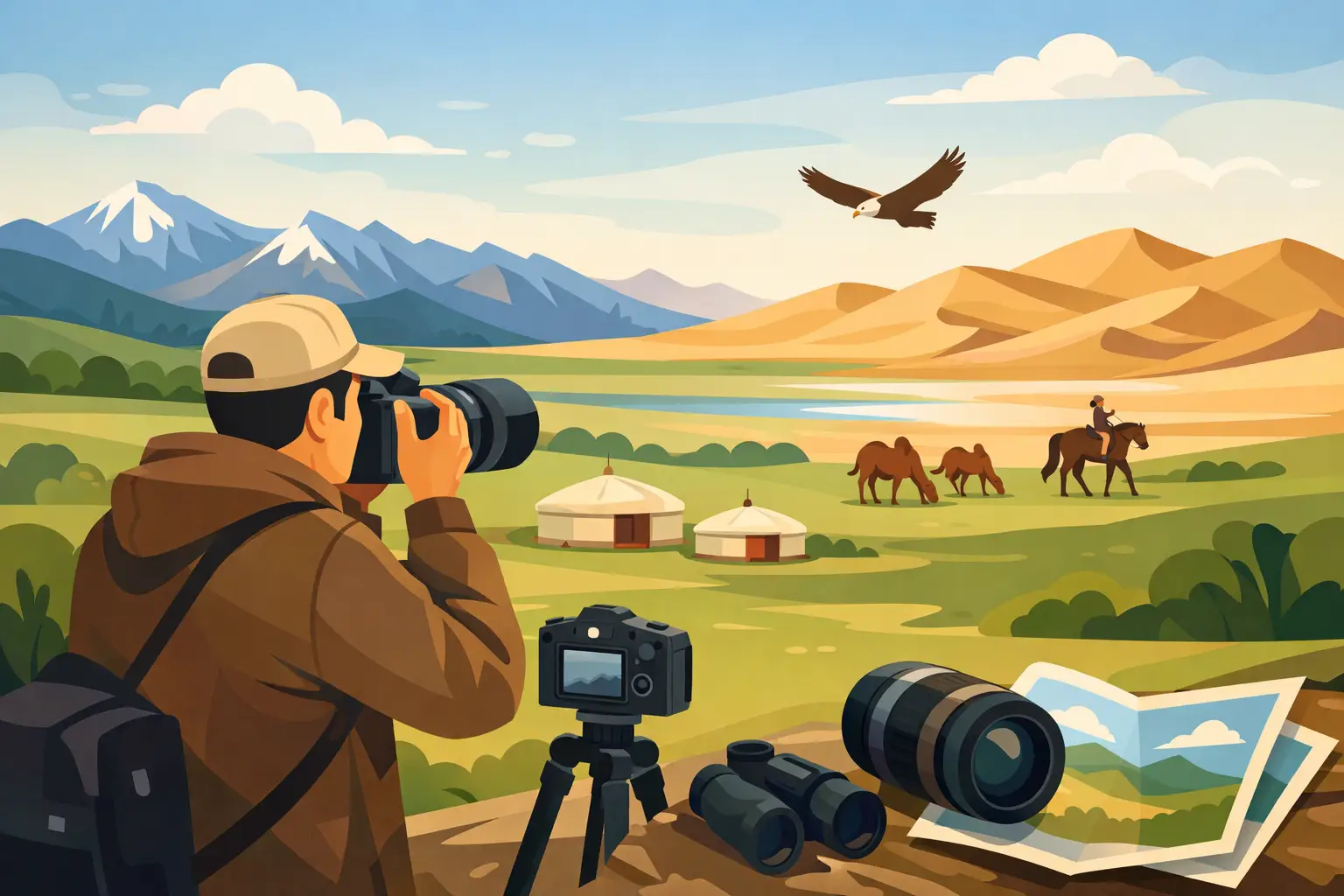
A Mongolian horizon can make even experienced photographers pause: grassland rolling to a distant ridge, a lone ger beside a river, storm light moving across the steppe. Learning how to photograph Mongolian landscapes is less about chasing every famous view than working patiently with vast space, fierce weather, long travel days, and the living nomadic culture within the frame.
Mongolia rewards photographers who arrive prepared but stay flexible. A plan matters, particularly on remote routes through the Gobi, Altai, Khuvsgul region, and central steppe. Yet some of the strongest images happen between planned locations, when a dust storm fades, a herder brings animals home, or late light briefly reaches a sacred mountain.
Build your itinerary around light, not just landmarks
Distances in Mongolia are substantial, and much of the country lies beyond paved roads. A map may make two locations look close, but the route can involve slow tracks, river crossings, changing road conditions, or stops with nomadic families. If photography is a priority, avoid an itinerary that tries to cover too much ground each day.
Allow time at each landscape rather than treating it as a quick roadside stop. In the Gobi Desert, this may mean staying close to dunes or rocky valleys so you can photograph both sunrise and sunset. In western Mongolia, it may mean building extra time around mountain weather, which can change quickly and conceal the Altai peaks for hours or days.
The middle of the day is not always lost. Mongolia's big skies can produce dramatic clouds, hard-edged shadows, dust, and graphic compositions when the sun is high. Still, dawn and the final two hours before sunset often give the most flattering color, dimensional texture, and calmer conditions. Discuss this rhythm before departure with your guide and driver, especially on a private journey or photography-focused small group.
Let the sky carry part of the composition
Under the Eternal Blue Sky, a plain scene can become powerful when clouds, moonlight, or incoming weather provide structure. Use a wide lens, but do not automatically place the horizon in the center. Give the sky room when it is active; lower it when the land, a river line, or animal trail is doing the visual work.
A telephoto lens is equally valuable. It compresses distant ridges, isolates a white ger against a dark hillside, and picks out light falling on one portion of a broad valley. Mongolia is a place where wide, normal, and telephoto perspectives can all tell very different truths about the same view.
Choose the season for the photographs you want
There is no single best season for landscape photography in Mongolia. The right time depends on whether you want green steppe, festival energy, desert heat, autumn color, snow, or the quiet severity of winter.
Summer brings long days, accessible grasslands, and the movement of herding life. It is also the season for Naadam, when landscape images can include racing horses, wrestlers, archers, and families in traditional dress. Conditions can be bright, and afternoon thunderstorms are common in some regions, so carry a rain cover and be ready for fast-changing light.
Early fall is especially rewarding in the Altai. The light softens, the air can be clearer, and the Golden Eagle Festival and Sagsai Eagle Festival create opportunities for portraits and action photography alongside mountain landscapes. Nights become cold, and weather may limit access to higher areas, so warm layers and a realistic route remain essential.
Winter brings snowfields, frozen lakes, blue-hour color, and a stripped-back sense of scale. It also demands serious preparation. Batteries drain quickly, vehicles require dependable support, and comfort becomes part of safe photography. Winter images are often most successful when a smaller geographical area is explored deeply rather than attempting an ambitious cross-country route.
Spring can be beautiful but less predictable. The landscape is beginning to wake, while wind, mud, and variable temperatures can complicate travel. It suits travelers who value atmosphere and flexibility over guaranteed conditions.
Pack for dust, wind, cold, and long days
Remote Mongolia is not the place to bring only one body and one lens without a backup plan. Dust is a fact of travel on unpaved tracks, particularly in the Gobi and during dry periods. Keep a protective bag accessible in the vehicle, use a rain cover or simple cloth during wind, and change lenses inside whenever possible.
A practical landscape kit usually includes a wide-angle zoom, a mid-range zoom, and a telephoto lens. Bring spare batteries, extra memory cards, a sturdy tripod, lens cloths, a remote release if you use one, and a portable power solution. A circular polarizer can help with glare and deepen a blue sky, but use it lightly with ultra-wide lenses, where uneven darkening can look unnatural.
A tripod earns its place for sunrise, twilight, night skies, and deliberate long exposures. It should be stable enough for wind, not merely light enough to carry. On a journey with frequent camp changes, weigh every item against how often you will realistically use it.
Protect yourself as carefully as your camera. Sun, wind, and cold can make it hard to concentrate on composition. A brimmed hat, sunglasses, gloves that allow camera control, warm layers, and sturdy footwear will give you more patience when the light finally arrives.
Photograph scale with a human connection
Mongolia's open landscapes can look almost abstract without a point of reference. A horse rider, a flock of sheep, a ger, a vehicle on a distant track, or a person walking along a ridge can reveal the true scale of the land. These details should feel natural, not staged merely to fill a frame.
Nomadic families are central to the character of the countryside, but a home is not a backdrop. Ask permission before making close photographs of people, gers, livestock work, or private moments. Your Mongolian guide can help explain your interest and interpret local etiquette. Taking time to greet people and share tea when invited often matters far more than immediately raising a camera.
At festivals, excitement can make photographers forget personal space. Work respectfully around eagle hunters, riders, and families. Do not block participants, step into active areas, or use intrusive flash. The best cultural photographs come from attention and restraint as much as technical skill.
Work with the realities of a Mongolia photography route
A productive day may start before sunrise, include a long drive, and end after dinner with file backups under a ger roof. Build a simple routine: clean equipment, charge batteries whenever power is available, back up images to two separate places, and make a few notes about locations and encounters while they are fresh.
Internet and electricity can be limited outside towns. Do not rely on cloud storage as your only backup. Bring sufficient storage and charging capacity, and accept that some evenings are better spent reviewing a few frames, then resting for the next early start.
Weather and road conditions sometimes require a change of plan. This is not a failure of the journey. A local guide and experienced driver can identify safer routes, alternative valleys, and worthwhile stops that are not obvious from a map. For photographers, that flexibility often becomes an advantage: an unplanned camp, a rain-cleared sky, or a detour through a quieter area can produce the day’s defining image.
Slow down enough to see the landscape
The most memorable Mongolia photographs rarely come from collecting locations. They come from returning to a ridge as the light changes, waiting beside a lake in still air, or watching a family’s evening herding routine until the right moment appears. A thoughtfully paced small-group or tailor-made photography journey creates room for that patience while keeping transport, camps, meals, and local guidance reliably organized.
Set your exposure, protect your equipment, and then look beyond the viewfinder. The wind over the steppe, the silence after sunset, and the generosity of a nomadic welcome will shape how you photograph Mongolia as much as any lens ever can.
Plan Your Mongolia Journey
Explore locally operated tours or ask our Mongolia team to tailor a private journey.