Discover Mongolia winter tours for 2026–2027, from the remote Darkhad Valley and reindeer herders of northern Mongolia to frozen Khuvsgul Lake, winter eagle hunters and the Gobi Desert. Journey Mongolia offers carefully planned small-group and private winter trips for travelers seeking authentic culture, spectacular winter landscapes and experiences far beyond the usual tourist routes.
The Mongolia winter travel season runs from November to March. During these months, frozen lakes, snow-covered valleys and vast open landscapes reveal a completely different side of the country. Travelers can stay with local communities, meet reindeer herders and eagle hunters, experience Mongolia’s winter festivals and explore regions visited by very few international travelers.
Our Mongolia winter tours range from true northern expeditions to festival journeys and shorter winter adventures. Below you can compare the best winter experiences, travel dates and destinations and choose the journey that suits you.
WHY VISIT MONGOLIA IN WINTER?
The first reason is simple: very few international travelers see Mongolia this way.
Summer is Mongolia's main tourism season. Winter is dramatically quieter.
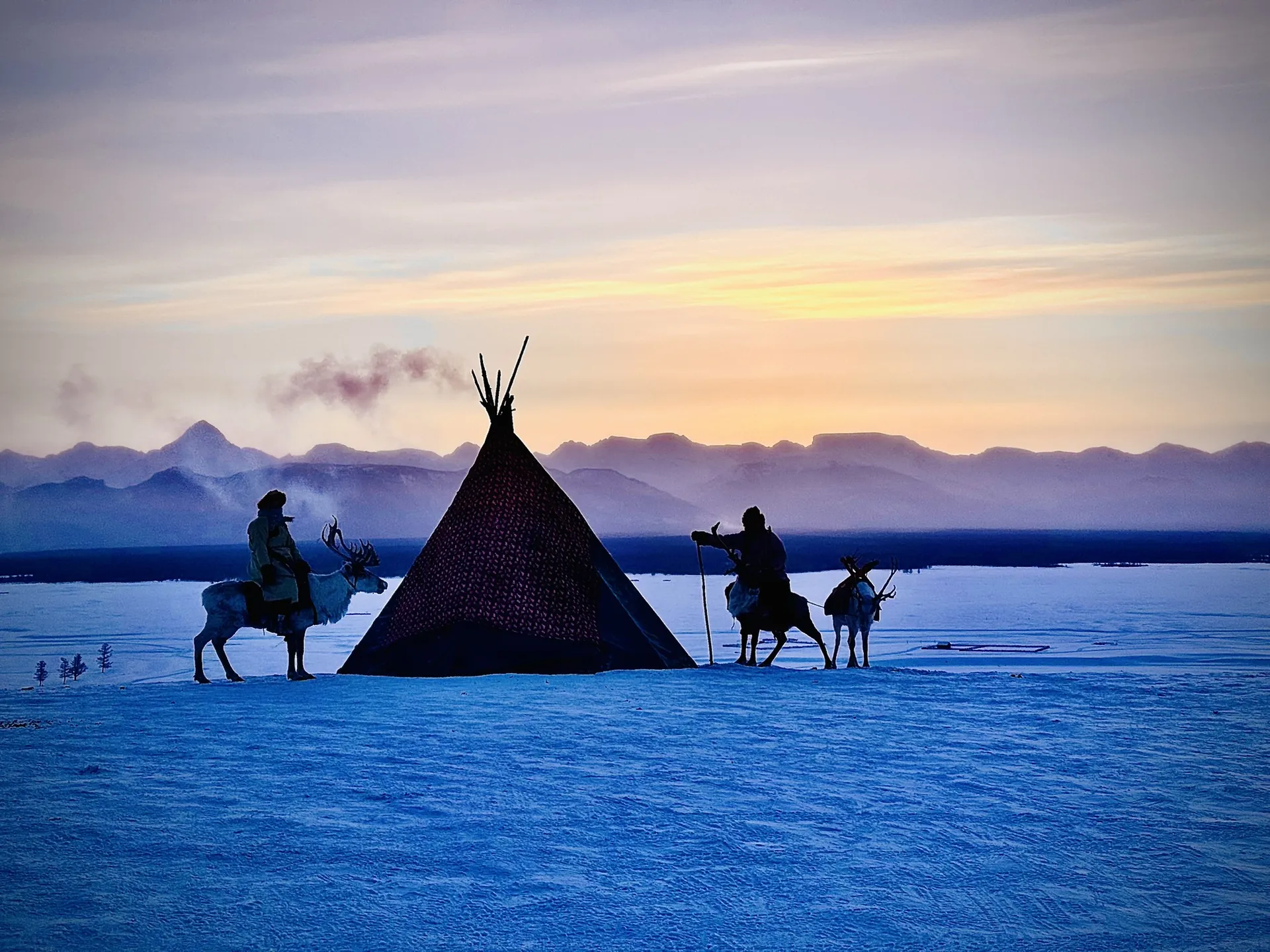
Once you leave Ulaanbaatar, enormous landscapes can feel almost completely empty. Snow-covered valleys stretch toward distant mountains, frozen rivers become part of the road network, and the low winter sun creates beautiful conditions for landscape and cultural photography.
But scenery is only part of the experience.
Winter also provides an opportunity to understand Mongolian life from a completely different perspective.
You see how families heat their gers, care for livestock during freezing conditions, prepare food, travel between settlements and organize daily life when temperatures remain below freezing.
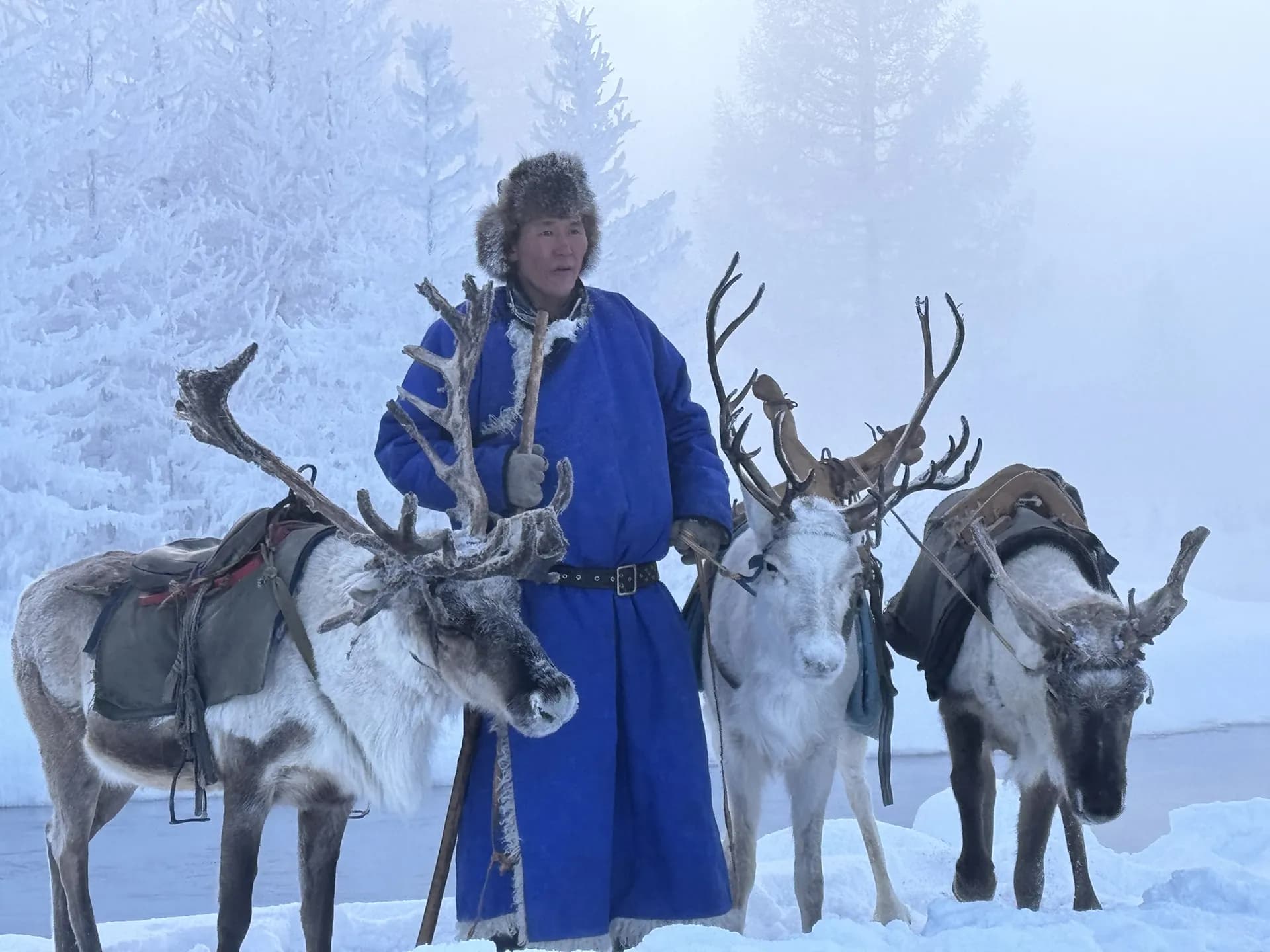
In northern Mongolia, winter offers opportunities to travel toward the Darkhad Valley and taiga and meet reindeer-herding communities.
In western Mongolia, Kazakh eagle-hunting culture can be experienced against spectacular snow-covered landscapes.
In the Gobi, Bactrian camels grow their thick winter coats and desert landscapes become almost unrecognizable compared with summer.
This is Mongolia without the summer crowds.
HOW COLD IS MONGOLIA IN WINTER?
There is no reason to pretend otherwise: Mongolia can be extremely cold.
During the heart of winter, temperatures frequently remain well below freezing, and conditions vary considerably by region, elevation, weather and time of day.
Ulaanbaatar is one of the coldest capital cities in the world, while remote northern valleys can experience considerably more severe conditions, particularly overnight.
The important question, however, is not simply:
"How cold is Mongolia?"
It is:
"Am I properly prepared for it?"
With good thermal layers, an insulated winter jacket, proper boots, gloves, head protection and realistic expectations, winter travel becomes an extraordinary experience rather than simply an exercise in enduring the cold.
For serious winter expeditions, clothing is part of the equipment — not a fashion decision.
WHEN IS THE BEST TIME FOR A MONGOLIA
WINTER TOUR?
There is no single best month to visit Mongolia in winter. It depends on what you want to experience.
NOVEMBER — THE BEGINNING OF WINTER
November is an excellent transition into Mongolia's winter season.
Temperatures have dropped significantly, tourist numbers are extremely low and northern landscapes begin taking on their full winter character.
It can be a good choice for travelers who want a winter expedition without deliberately choosing the deepest part of January.
DECEMBER — DEEP WINTER AND EXTRAORDINARY SILENCE
December brings shorter days and genuine winter conditions.
Snow, frozen rivers and remote landscapes make this an excellent period for photography and cultural journeys.
It is also a fascinating time to see Mongolia far outside its conventional tourism season.
JANUARY — MONGOLIA AT ITS WILDEST
January is for travelers who specifically want winter.
It can be intensely cold, especially in northern Mongolia, but that is precisely what creates the experience.
Frozen landscapes, winter camps, clear air and almost complete absence of tourism can make January extraordinary for photographers and experienced adventure travelers.
FEBRUARY — WINTER WITH MORE DAYLIGHT
February remains cold, but daylight begins to increase.
It is an excellent month for winter expeditions and can also coincide with seasonal celebrations and events depending on the annual calendar.
LATE FEBRUARY AND EARLY MARCH — FESTIVAL SEASON
This is one of the most interesting periods for travelers who want to combine winter landscapes with cultural events.
Depending on the year's confirmed schedules, Mongolia's winter calendar can include events such as the Khuvsgul Ice Festival and camel festivals in the Gobi.
Festival dates should always be checked before booking because schedules can change from year to year.
NORTHERN MONGOLIA: REINDEER HERDERS
AND THE DARKHAD VALLEY
For travelers searching for a true Mongolia winter expedition, northern Mongolia is difficult to match.
Beyond Murun, the journey enters increasingly remote country before reaching the enormous Darkhad Valley.
In winter, forests, frozen rivers, mountains and open plains create one of Mongolia's most dramatic landscapes.
Travel itself becomes part of the expedition.
Distances are long. Roads are not always roads in the conventional sense. Weather and snow conditions matter. Plans sometimes need to remain flexible.
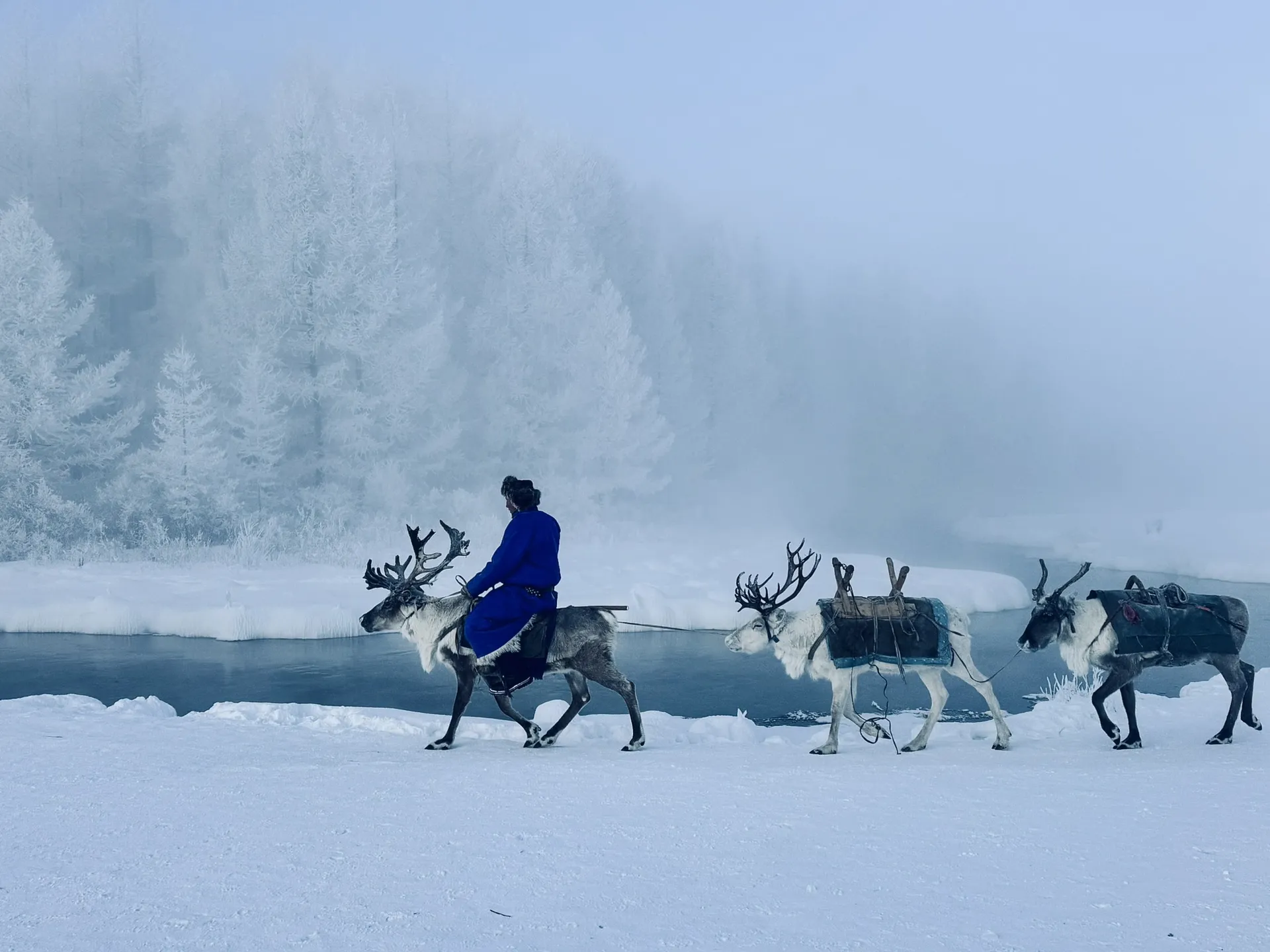
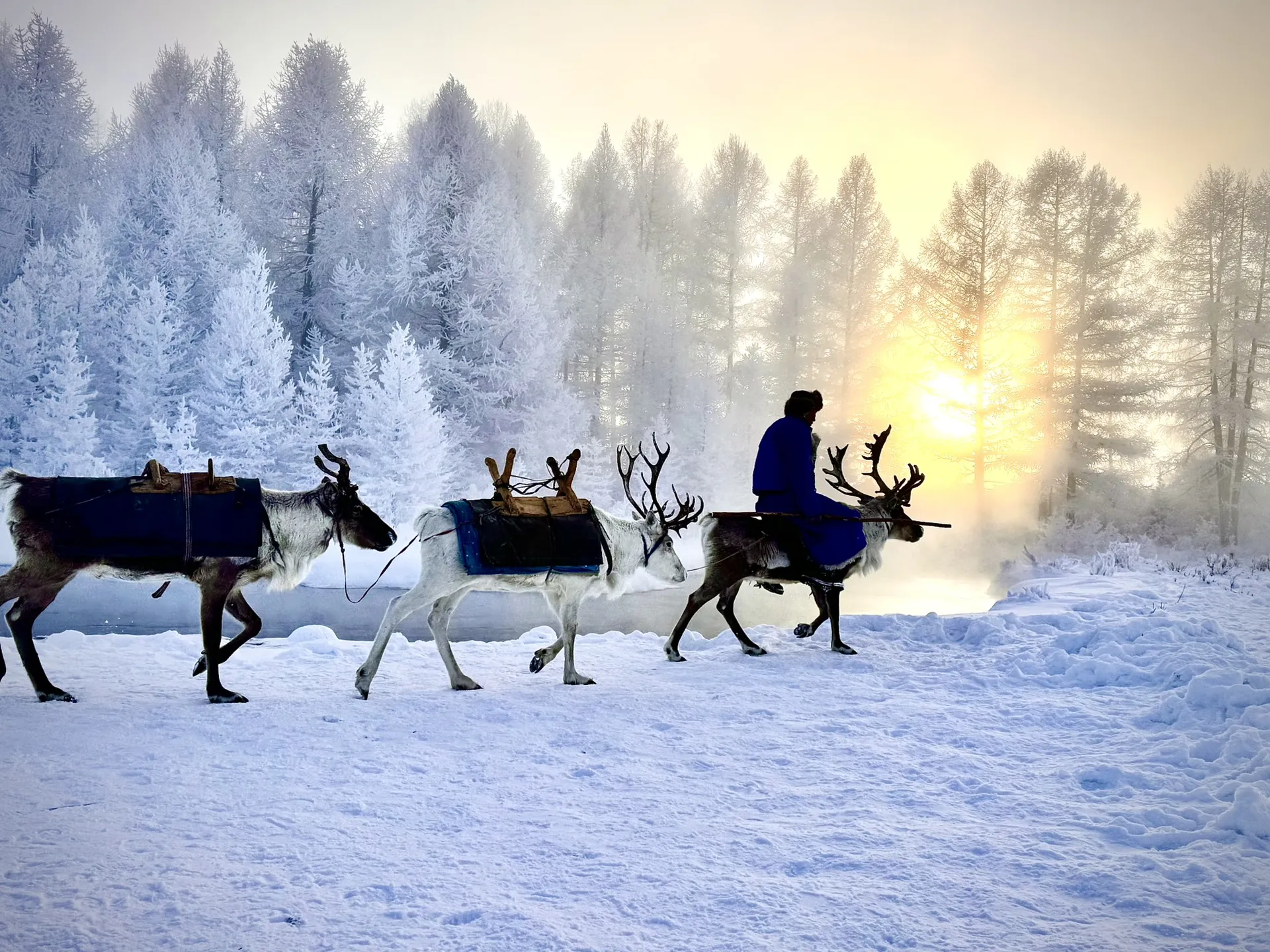
Eventually, journeys can reach areas associated with Mongolia's reindeer-herding communities, often known internationally as the Tsaatan or Dukha.
A meaningful visit should not be treated as a staged attraction.
The purpose is to spend time in the region, meet people respectfully and learn about a way of life shaped by the taiga, reindeer and generations of adaptation to northern Mongolia.
For photographers and travelers interested in living culture rather than conventional sightseeing, this can become the defining experience of a journey to Mongolia.
WHAT IS A REAL WINTER EXPEDITION LIKE?
This is important because not every Mongolia winter tour is the same.
A short winter excursion around Ulaanbaatar can include comfortable accommodation and relatively easy logistics.
A journey deep into northern Mongolia is different.
You should expect some long driving days, basic accommodation in remote regions, changing road conditions and occasional itinerary adjustments.
Internet access may be limited or unavailable.
Bathrooms and hot water may be basic outside major towns.
Flights and overland travel can sometimes be affected by winter conditions.
And not every day needs to contain five tourist attractions.
Sometimes the experience is simply driving through an enormous frozen valley, stopping beside a river, meeting a family or watching the landscape change as the winter light disappears behind the mountains.
That is part of the reason to come.
WHERE DO YOU SLEEP DURING A MONGOLIA
WINTER TOUR?
Accommodation depends heavily on the itinerary.
In Ulaanbaatar and provincial centers, travelers generally stay in hotels or guesthouses.
Outside towns, accommodation can include heated traditional gers, local guesthouses and family-based accommodation.
A Mongolian ger is remarkably well suited to winter when properly heated.
A stove in the center provides warmth, but travelers should understand that the experience is not the same as staying in a city hotel.
In remote regions, facilities may be shared and electricity, running water, showers and internet access can be limited.
For many travelers, this becomes one of the most memorable parts of the journey.
You are not separated from winter by a hotel corridor.
You are living inside it.
MONGOLIA WINTER PHOTOGRAPHY
Winter transforms Mongolia into an exceptional photography destination.
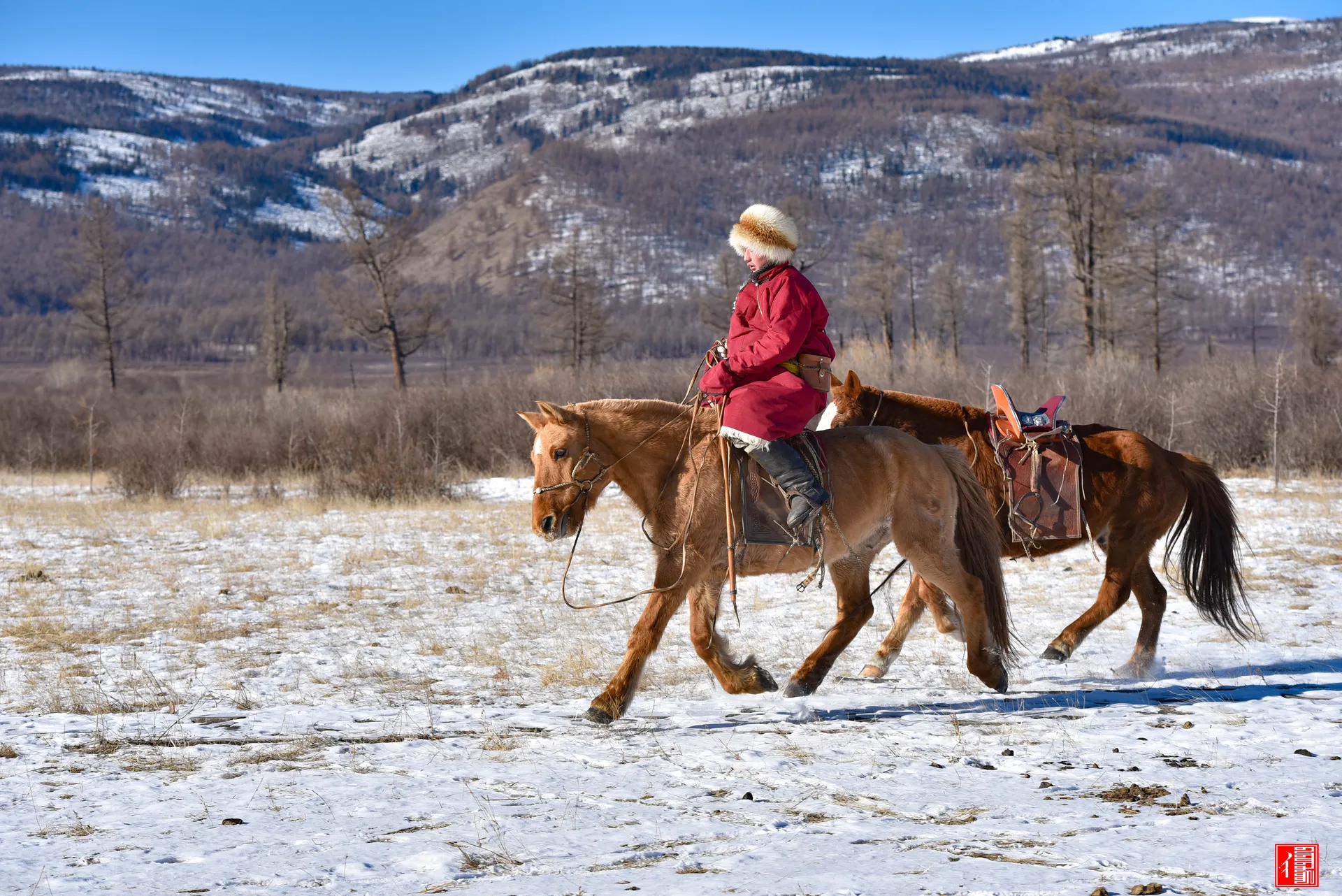
The landscape becomes visually simpler: white snow, dark mountains, horses, reindeer, camels, smoke rising from gers and people dressed for severe cold.
Low winter sunlight can produce long shadows and warm tones across snow-covered landscapes.
Potential subjects include:
• Reindeer herders and taiga life
• Kazakh eagle hunters
• Horses in winter pasture
• Bactrian camels with thick winter coats
• Frozen rivers and lakes
• Ger camps and nomadic winter life
• Snow-covered mountains and forests
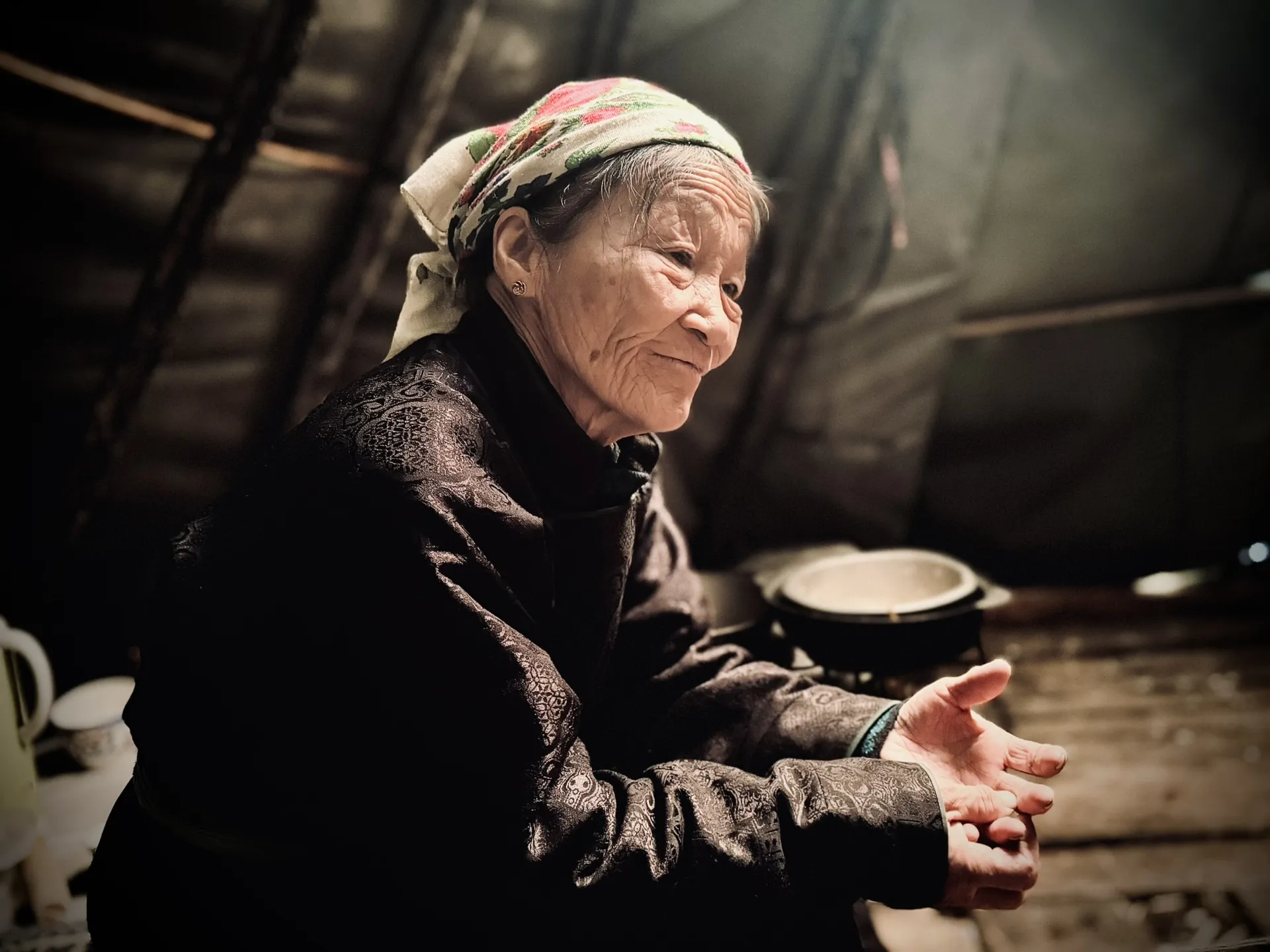
• Winter portraits
• Night skies and stars
Cold weather creates additional challenges for cameras and batteries, so photographers should travel with spare batteries and appropriate protection for equipment.
But the visual rewards can be exceptional.
EAGLE HUNTERS IN WINTER
Mongolia's Kazakh eagle-hunting tradition is most strongly associated with Bayan-Ölgii in western Mongolia.
The famous Golden Eagle Festival takes place during the autumn festival season, but eagle hunting itself is part of a living cultural tradition rather than something that exists only for a festival.
Winter landscapes can provide an extraordinary setting for meeting eagle-hunting families and learning about the relationship between hunter, horse and golden eagle.
Travelers primarily interested in the main Golden Eagle Festival should plan for the autumn festival dates rather than assume that every winter journey includes a festival.
For photographers, however, western Mongolia in colder conditions can offer a completely different visual experience from the busy festival environment.
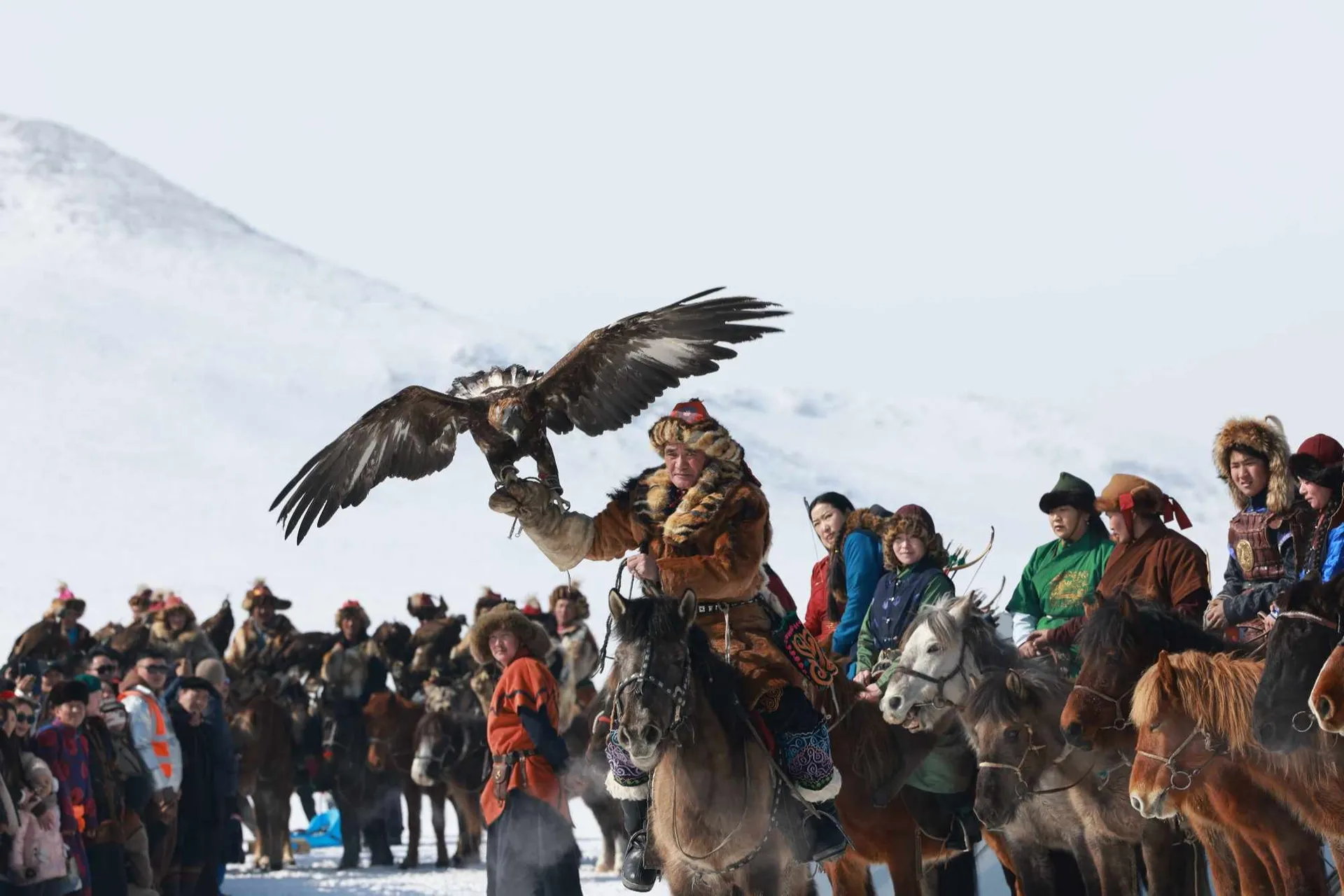
Kazakh eagle hunter on horseback in winter Mongolia
THE GOBI DESERT IN WINTER
Many people imagine the Gobi as permanently hot.
It isn't.
The Gobi experiences severe winters, and snow can cover parts of the desert.
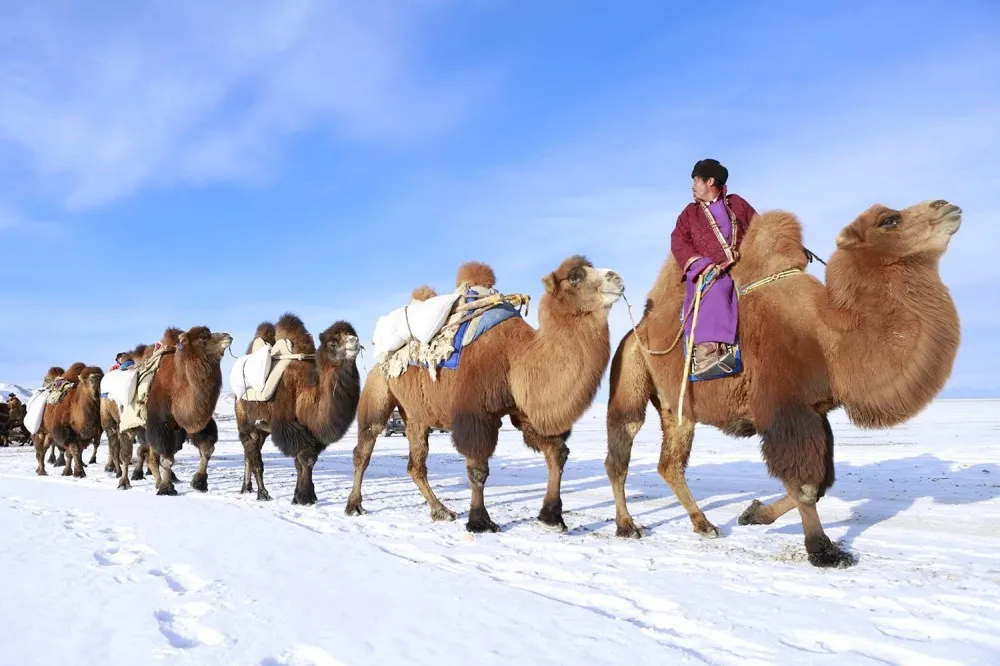
Bactrian camels are particularly impressive during the colder months because of their thick winter coats.
A winter Gobi journey can combine desert landscapes, camel-herding families and seasonal cultural events.
Late winter and early spring can also bring camel festivals, where communities celebrate the importance of the Bactrian camel through races, competitions and traditional activities.
It is one of Mongolia's great seasonal contrasts: camels, snow and desert in the same journey.
KHUVSGUL LAKE AND THE ICE FESTIVAL
Lake Khuvsgul becomes one of Mongolia's most spectacular winter landscapes when frozen.
The surrounding mountains, forests and immense frozen surface create a completely different atmosphere from the lake's busy summer season.
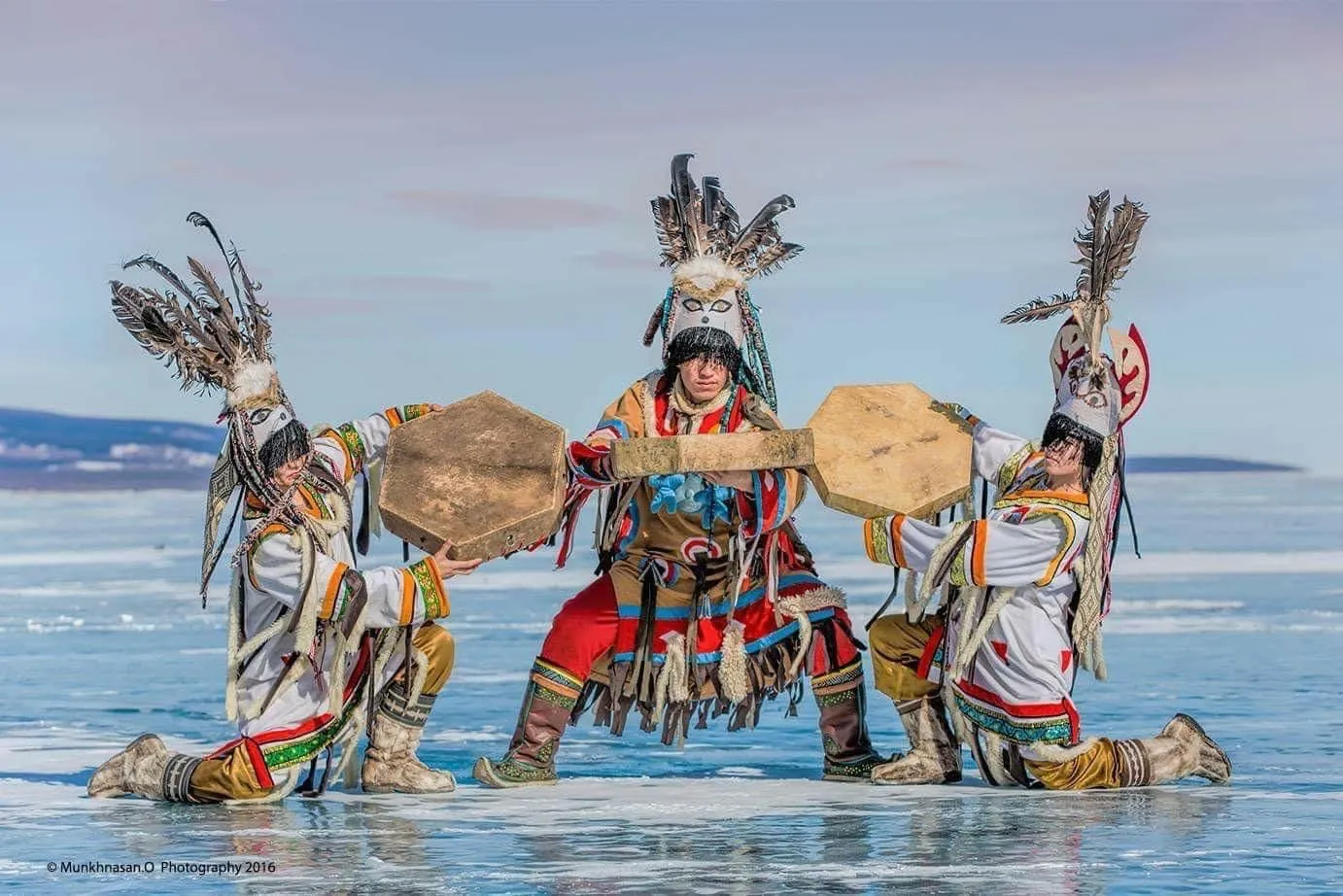
Around the end of winter, the Khuvsgul Ice Festival traditionally brings together local communities for activities and celebrations on and around the frozen lake.
Travelers planning specifically around the festival should always confirm the official dates for their travel year before purchasing international flights.
Combining Khuvsgul with other northern experiences can create one of Mongolia's strongest winter itineraries.
IS MONGOLIA SAFE TO VISIT IN WINTER?
Winter travel in Mongolia requires more preparation than an ordinary city holiday.
Cold temperatures, long distances and remote areas mean that logistics matter.
A well-organized winter journey should consider:
• Suitable vehicles for the route
• Experienced local drivers
• Appropriate winter clothing
• Accommodation and heating
• Communication in remote areas
• Weather and road conditions
• Realistic driving times
• Emergency planning
• Flexible routing when conditions change
The goal is not to eliminate every element of adventure.
It is to manage the journey professionally while respecting the realities of traveling through Mongolia in winter.
This is one reason experienced local organization becomes especially important on remote winter routes.
WHAT SHOULD YOU PACK FOR MONGOLIA IN WINTER?
For a serious Mongolia winter journey, layering is essential.
A practical system normally includes:
• Thermal base layers
• Insulating mid-layers
• Heavy insulated winter jacket
• Wind-resistant outer layer where appropriate
• Warm winter trousers
• Proper insulated winter boots
• Thick winter socks
• Warm hat covering the ears
• Insulated gloves or mittens
• Neck warmer or balaclava
• Sunglasses
• Sunscreen
• Lip balm and moisturizer
• Personal medications
• Power bank
• Spare camera batteries
For remote northern expeditions, equipment recommendations should be discussed with your tour operator before departure.
Do not assume that ordinary city winter clothing will automatically be sufficient for northern Mongolia.
WHO SHOULD CHOOSE A MONGOLIA WINTER EXPEDITION?
A winter expedition can be ideal for adventure travelers who value experience over luxury.
It is particularly rewarding for photographers looking for landscapes, culture and unusual winter light; repeat visitors who have already experienced Mongolia in summer; cultural travelers interested in nomadic, Kazakh or reindeer-herding traditions; and small groups or private travelers who prefer remote journeys to mass tourism.
And perhaps most importantly, it suits people who understand that the unexpected is part of adventure travel.
WHO SHOULD THINK CAREFULLY BEFORE BOOKING?
A remote winter expedition may not be the right choice if your priority is guaranteed luxury every night, perfectly predictable schedules or warm weather.
It may also be unsuitable for travelers who are uncomfortable with long overland journeys, basic remote accommodation or significant cold.
There is nothing wrong with that.
Mongolia offers many other ways to travel.
Choosing the right trip is more important than choosing the most extreme one.
WINTER MONGOLIA VS SUMMER MONGOLIA
Summer Mongolia is green, active and relatively busy.
Winter Mongolia is quieter and more introspective.
In summer, travelers may encounter other tour vehicles at major attractions.
In winter, you may drive for hours through a landscape without seeing another traveler.
Summer offers Naadam, hiking, horse trekking and easier camping.
Winter offers frozen landscapes, winter camps, reindeer culture, eagle hunting, Bactrian camels in full winter coats and an entirely different understanding of how people live in Mongolia.
Neither season is better.
They are almost two different destinations.
WINTER REINDEER & DARKHAD VALLEY EXPEDITION
For travelers who want to experience northern Mongolia beyond the usual tourist routes, Journey.mn operates the Winter Reindeer & Darkhad Valley Expedition.
This 10-day journey travels from Ulaanbaatar through Hustai National Park and Murun before continuing north into the Darkhad Valley, Ulaan-Uul, Tsagaan Nuur and the East Taiga.
The focus is not simply sightseeing.
It is a combination of wilderness, winter landscapes, photography and meaningful encounters with reindeer-herding communities.
Scheduled departures are available during the 2026–2027 winter season.
Explore the Winter Reindeer & Darkhad Valley Expedition and discover one of Mongolia's most extraordinary winter journeys.
FREQUENTLY ASKED QUESTIONS ABOUT
MONGOLIA WINTER TOURS
IS MONGOLIA TOO COLD TO VISIT IN WINTER?
Mongolia is extremely cold in winter, but properly equipped travelers can experience it with suitable planning. The more remote the itinerary, the more important appropriate clothing and professional logistics become.
WHAT IS THE COLDEST MONTH IN MONGOLIA?
January is generally among the coldest periods of the Mongolian winter. Conditions vary considerably by region.
CAN I STAY IN A GER DURING WINTER?
Yes. Mongolian families have lived in gers through winter for generations. Properly heated gers can be very warm, although remote facilities may be much simpler than hotels.
CAN I SEE REINDEER IN MONGOLIA DURING WINTER?
Yes. Specialized northern itineraries can provide opportunities to visit reindeer-herding communities. These journeys require substantially more logistics than ordinary sightseeing tours.
CAN I VISIT THE GOBI DESERT IN WINTER?
Yes. The Gobi is accessible during winter, although conditions are very different from summer and routes should be planned according to weather and road conditions.
ARE THERE WINTER FESTIVALS IN MONGOLIA?
Yes. Mongolia has several seasonal winter events, including celebrations associated with frozen Lake Khuvsgul and Bactrian camel culture. Exact dates can vary and should be confirmed for the relevant year.
IS MONGOLIA GOOD FOR WINTER PHOTOGRAPHY?
It can be exceptional. Snow, low-angle light, remote landscapes, animals and traditional winter life create photographic opportunities that are very different from Mongolia's summer season.
DO I NEED TRAVEL INSURANCE?
Comprehensive travel insurance is strongly recommended for Mongolia, particularly for remote winter travel. Travelers should ensure their policy is appropriate for the destinations and activities included in their itinerary.
EXPERIENCE MONGOLIA BEYOND THE TOURIST SEASON
Most people dream of Mongolia as a summer destination.
Come in winter and you will meet another Mongolia.
A quieter Mongolia.
A Mongolia of frozen rivers, steaming gers, horses standing beneath snow-covered mountains, Bactrian camels wrapped in their natural winter coats and reindeer moving through the northern taiga.
It is colder.
It requires more preparation.
Sometimes the road takes longer than expected.
But for the right traveler, those are not reasons to avoid Mongolia in winter.
They are part of the reason to come.
Ready to experience Mongolia in winter?
Explore our Mongolia winter tours or contact the Journey.mn team to design a private winter journey through the Gobi, northern Mongolia, the Darkhad Valley or western Mongolia.