Mongolia Travel Blog
What Mongolia Ger Camps Are Really Like to Stay In
Plan a comfortable, respectful stay in Mongolia ger camps, from shared bathrooms and camp meals to seasons, packing, etiquette, and remote travel details.
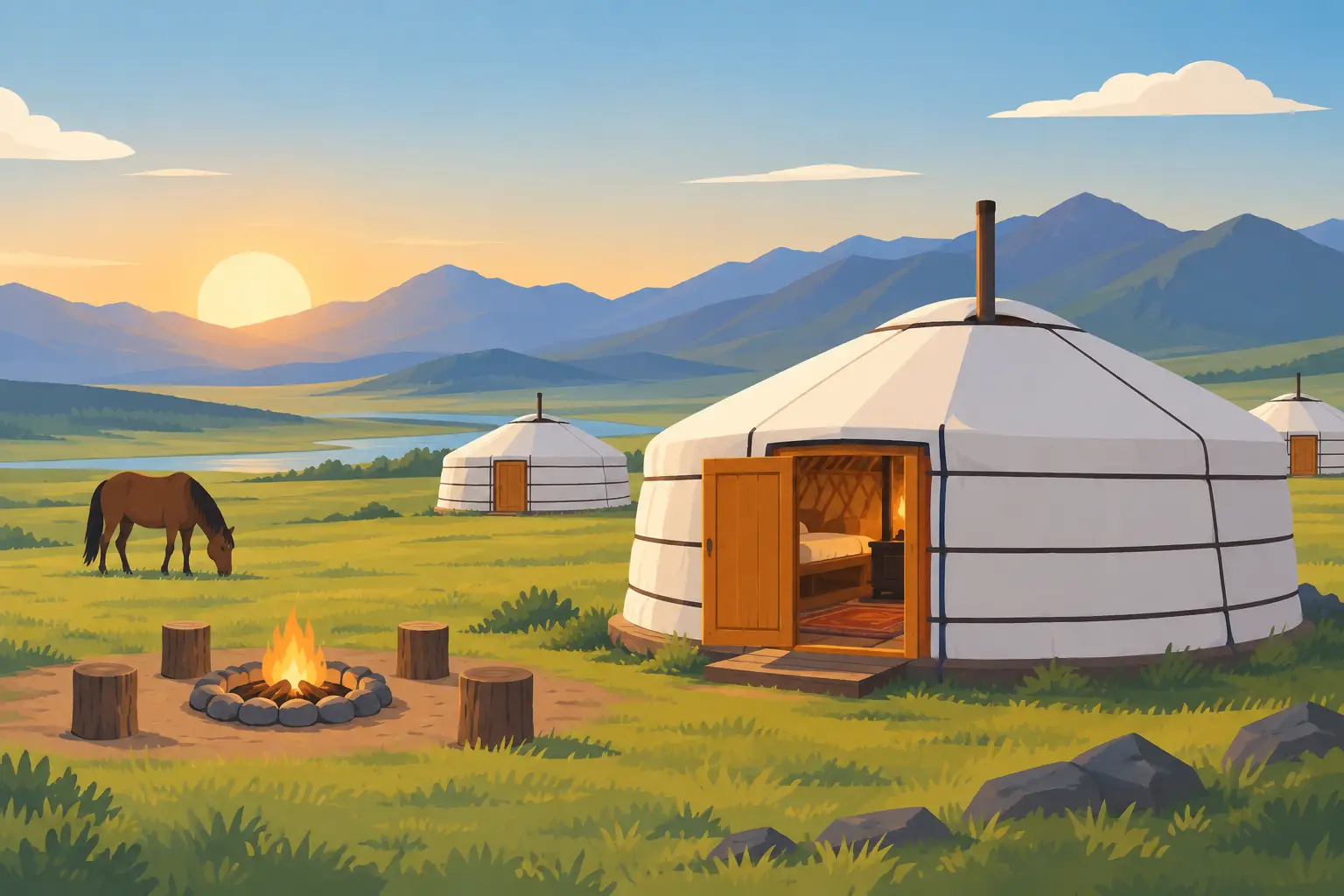
A ger door opens onto a wide horizon: sand dunes glowing at dawn, horses moving across the steppe, or a lake held beneath the Eternal Blue Sky. Mongolia ger camps make these landscapes accessible without requiring travelers to carry camping equipment or give up a proper bed at the end of a long day. They are a defining part of travel here, but they are not all alike.
Some camps are established seasonal properties with rows of guest gers, dining rooms, showers, and reliable staff. Others are small, family-run places in remote valleys where the experience is simpler and closer to the rhythm of nomadic life. Knowing the difference helps set the right expectations and lets you choose an itinerary that matches your preferred balance of comfort, adventure, and cultural connection.
What Is a Ger Camp?
A ger is Mongolia's traditional circular, portable home, known internationally by the Russian word yurt. Its wooden frame is covered with layers of felt and a protective outer canvas. The design has evolved over centuries to withstand strong wind, dry heat, and dramatic temperature changes, while remaining practical for families who move with their animals seasonally.
In a tourist ger camp, guests generally stay in individual or shared gers set around an open central area. Inside, expect real beds, bedding, a small table or stools, and often a stove for warmth when conditions require it. The interior may be plainly furnished or more decorative, with painted wooden poles, patterned textiles, and traditional household items.
A ger is not a hotel room shaped like a tent. Sound carries easily, the door may be low, and insulation depends on the season and camp standard. Yet its solid circular structure feels surprisingly sheltered in open country. Falling asleep under felt walls, then stepping outside to a sky bright with stars, is one of the quiet pleasures of a journey through Mongolia.
Established camps and nomadic family stays
Established camps are usually the best fit for travelers who want dependable logistics after full days of driving, hiking, riding, or photography. They commonly provide a separate dining ger or restaurant-style building, shared bathroom facilities, and electricity at least during certain hours. In popular regions such as the Gobi Desert, Khustai National Park, and around Khuvsgul Lake, standards can range considerably from simple to very comfortable.
A stay with a nomadic family is different. You may sleep in a guest ger or in a space arranged for visitors, and facilities can be basic. The reward is not staged entertainment but the chance to observe daily life respectfully: animals being milked, felt being prepared, meals cooked over a stove, and family routines shaped by weather and livestock. These visits need thoughtful planning, clear local coordination, and flexibility from guests. They should never be approached as a performance.
The Comfort Level at Mongolia Ger Camps
Most travelers find ger camps more comfortable than they expect, provided they arrive with realistic expectations. Beds are normally proper single beds rather than sleeping mats, although mattress firmness and room space vary. Couples may be assigned a double bed or two singles, depending on the camp. Private gers are common on tailor-made journeys, while small-group departures may use twin-share arrangements.
Bathrooms are frequently separate from the sleeping gers. At better-equipped camps, there may be modern toilets, hot showers, sinks, and changing areas. In more remote areas, water supply can be limited, shower availability may be scheduled, and toilets may be simpler. The distance from your ger to the bathroom can feel insignificant in daylight and rather more memorable on a cold, windy night.
Electricity also varies. Some camps run generators at set times; others use solar power with limited charging capacity. Bring a power bank for cameras and phones, especially on longer routes through the Gobi or western Mongolia. Do not assume Wi-Fi, strong cell signal, air conditioning, or round-the-clock power. Those absences are often part of why a ger camp feels genuinely removed from ordinary routine.
Meals, water, and dietary needs
Meals are typically served in a communal dining ger or dining hall. Mongolian food is built around meat, dairy, flour, and warming soups, though established camps serving international travelers often offer vegetables, rice, noodles, salads, and familiar breakfast choices as well. In rural places, ingredients reflect what can be transported and stored, so variety may be narrower than in Ulaanbaatar.
Vegetarian, vegan, gluten-free, and allergy-sensitive travelers should share requirements well in advance. Mongolia can accommodate many needs with good preparation, but remote camps have limited supply chains and substitutions are not always possible. Carrying a few preferred snacks is sensible, particularly for long driving days.
Your guide or camp team will advise on drinking water. Refillable bottles and a personal purification method can be useful on adventurous routes, while bottled or treated water is often available at established camps. Reducing single-use plastic matters in a country where waste collection becomes more difficult the farther one travels from towns.
Seasons Change the Ger Camp Experience
The same camp can feel entirely different in June and October. Summer brings long light, open roads, green steppe in many regions, and the main operating season for many ger camps. Days can be hot, especially in the Gobi Desert, while evenings may still turn cool. A light insulating layer is useful even in midsummer.
Spring and fall offer crisp air, fewer visitors, and beautiful photography conditions, but temperatures are less predictable. Ger stoves may be lit at night, and camps in high-altitude or northern regions can be distinctly cold. These shoulder periods suit travelers who enjoy changing weather and quieter landscapes, provided their itinerary allows for road and temperature variability.
Winter ger stays are possible on specialized journeys, but they are a serious cold-weather experience rather than an extension of summer travel. A heated ger can be cozy near the stove and cold farther from it. Quality insulated clothing, careful vehicle planning, and experienced local support are essential, especially in the Darkhad Valley or other remote northern areas.
Practical Etiquette Inside a Ger
A ger is a home as well as a place to sleep, and a few simple customs show respect. Step over the threshold rather than on it, and avoid leaning against the central support poles. When visiting a family ger, wait to be invited to sit and follow your guide's advice about where to place bags or photography equipment.
Accepting offered tea, dairy products, or food with the right hand or both hands is polite. If you cannot eat something, a warm and gracious explanation is better than an abrupt refusal. Ask before photographing people, children, religious objects, or private household moments. This is especially important during family visits and at festivals, where a meaningful image begins with trust.
Shoes are often removed inside a private family ger, though practice can differ at guest camps. Your guide will help interpret the setting. Small gestures of consideration go a long way in Mongolia's nomadic heartland.
How Ger Camps Shape Your Itinerary
Ger camps are not simply overnight stops. Their locations determine the pace of a Mongolia journey. A map may show two places as close, yet the route between them can involve unpaved tracks, river crossings, mountain passes, livestock on the road, and hours without services. A well-designed itinerary allows time to arrive before dark, settle in, enjoy a meal, and take in the landscape rather than treating every day as a race between distant points.
For the Gobi, camps provide a practical base near dunes, canyons, fossil areas, and vast desert plains. In the Altai, they support journeys to eagle hunter communities and festival grounds, where distances are substantial and weather can change quickly. Around Khuvsgul Lake, a camp stay may place you close to shore walks, horse riding, and early-morning light over the water.
Photography travelers should consider camp positioning carefully. A ger camp with open views may offer excellent sunrise, Milky Way, or portrait opportunities, while camps close to busy roads or larger visitor areas may feel less secluded. For private journeys, it can be worth prioritizing location and camp character over superficial amenities alone.
What to Pack for a Better Stay
Pack for changing conditions rather than the calendar alone. A warm layer, windproof jacket, comfortable slip-on shoes for bathroom trips, headlamp, reusable water bottle, power bank, sleep mask, and earplugs are useful across much of the season. Add sunscreen and lip balm for dry, high-exposure landscapes. In colder months, thermal layers and insulated boots are essential.
Keep a small overnight bag accessible in the vehicle. Large luggage may remain packed while you settle into your ger, particularly on one-night stops. Soft-sided bags are often easier to manage than hard suitcases on remote driving routes.
The best Mongolia ger camps give travelers something increasingly rare: a place to rest within the landscape rather than apart from it. Choose them with the same care you give to a route, a guide, or a festival date, and the memory may be as lasting as the destination itself.
Plan Your Mongolia Journey
Explore locally operated tours or ask our Mongolia team to tailor a private journey.