Mongolia Travel Blog
Golden Eagle Festival Travel Guide for Mongolia
Plan your Golden Eagle Festival travel guide with practical advice on timing, Altai logistics, camps, etiquette, weather, and photography in Mongolia today.
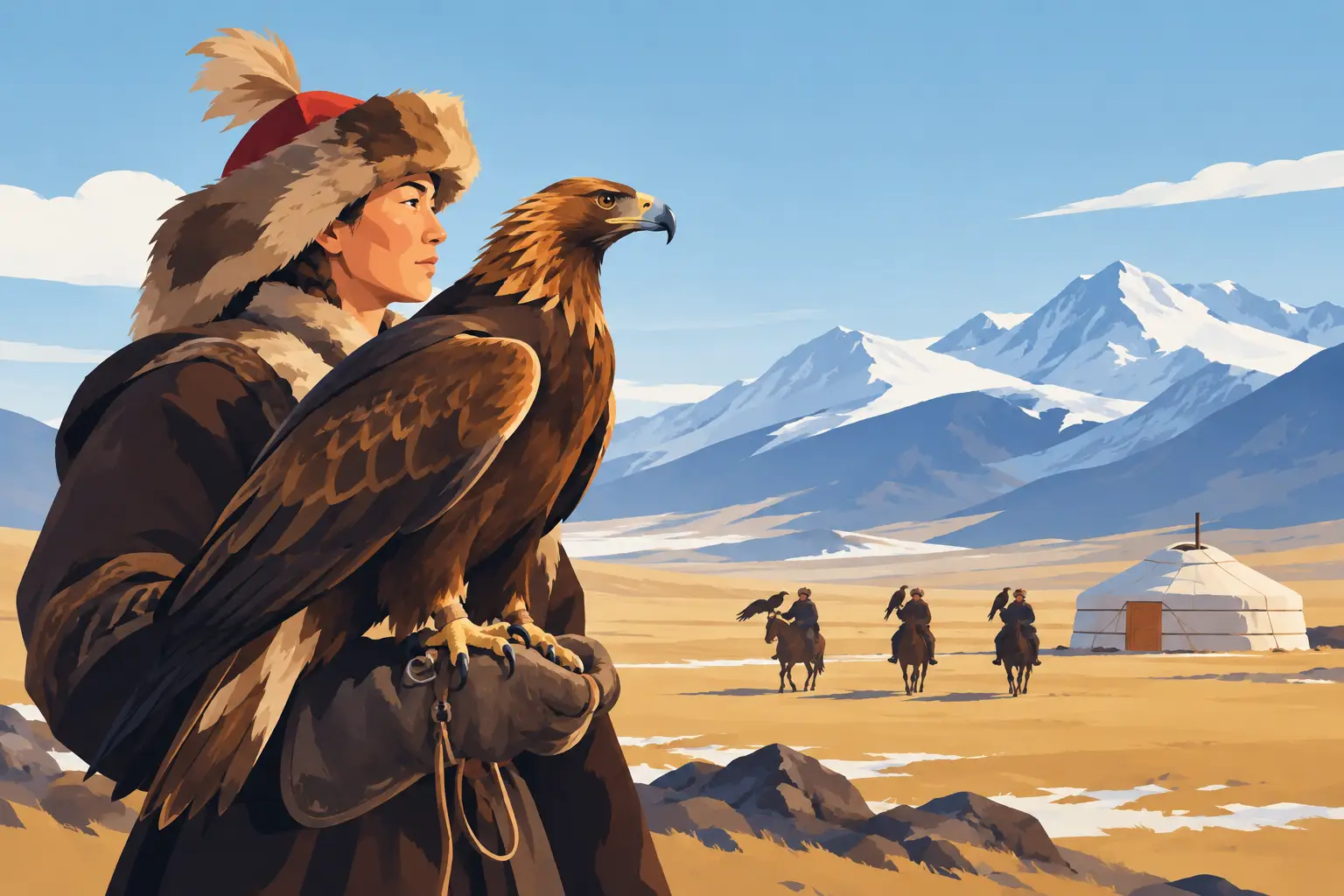
A Golden Eagle Festival travel guide should begin with one reality: this is not a festival you simply add to a city break. The celebration unfolds in Mongolia’s far west, where the Altai Mountains rise above wide Kazakh grasslands and autumn arrives with sharp light, cold mornings, and snow already visible on high ridges. Reaching it takes planning, but the reward is an unusually close encounter with the living tradition of eagle hunting.
The Golden Eagle Festival brings together Kazakh eagle hunters, known as berkutchi, and their families for competitions that test an eagle’s training, speed, response to its handler, and ability to locate its owner across the open steppe. For travelers, it is one of Mongolia’s most powerful cultural and photographic experiences. It is also a journey best approached with patience, respect, and realistic expectations about remote travel.
Where the Golden Eagle Festival takes place
The main Golden Eagle Festival is held near Ölgii, the provincial center of Bayan-Ölgii in western Mongolia. This is the heartland of Mongolia’s Kazakh community, whose language, dress, music, and family traditions give the region a distinct character within the wider nomadic heartland.
A separate Sagsai Eagle Festival is often held near Sagsai, west of Ölgii, and offers a more rural setting. The exact timing, venue, and format of both events can change from year to year, so travelers should confirm arrangements before booking international flights. Autumn is the traditional festival season, usually bringing stable skies alongside quickly changing mountain weather.
The setting matters as much as the competitions. Beyond the arena, you may see hunters arrive in embroidered coats and fur-trimmed hats, carrying golden eagles on their arms, while families watch from the grassland and horses move across the valley. The festival is competitive and celebratory, but it is not staged solely for visitors. It remains connected to a hunting heritage that Kazakh families have maintained for generations.
Choose the right festival and trip length
For most international visitors, the choice is between the larger event near Ölgii and the smaller Sagsai gathering. The larger festival generally has more participants and a busier atmosphere. It can be a good fit for first-time visitors who want the full program, more activity, and a wider range of photographic scenes.
Sagsai can feel more intimate, with a stronger sense of village and steppe life around the event. Its smaller scale may appeal to travelers who value quieter cultural contact, although facilities and logistics can be simpler. Neither is automatically better. The right choice depends on whether you prioritize spectacle, a particular itinerary, photography access, or time with local Kazakh families.
Allow enough time for western Mongolia rather than flying in for the festival alone. A well-paced journey usually includes arrival and departure buffers, time in or around Ölgii, and several days in the Altai countryside. Adding a stay with a Kazakh family, a visit to a local market, or drives through mountain valleys gives context to what you see at the festival.
Getting to Bayan-Ölgii
Most journeys begin in Ulaanbaatar, followed by a domestic flight to Ölgii when schedules operate. Flying saves considerable time, but weather, aircraft availability, and operational changes can affect domestic services. Build flexibility into both ends of your itinerary, particularly if you have a fixed international departure.
Overland travel is possible but is a major expedition across long distances, rough sections of road, and remote terrain. It suits travelers who have several weeks and genuinely want an extended western Mongolia route. For a festival-focused trip, flying is usually the sensible choice.
Once in Bayan-Ölgii, expect travel by four-wheel-drive vehicle. Festival grounds, family camps, and scenic valleys may be outside town, and road conditions range from paved stretches to dirt tracks. A local driver and guide are valuable not only for transport, but also for communication, timing, and understanding the customs around the event.
What accommodation is really like
Ölgii has simple hotels and guesthouses, while journeys into the countryside often use tourist ger camps, private ger stays, or tented arrangements depending on the route. A ger is Mongolia’s circular felt dwelling, warmed by a stove when temperatures drop. It is comfortable in a practical, memorable way, but it is not a city hotel room.
In remote camps, electricity may be limited, Wi-Fi is often unreliable, and bathrooms can be separate from the sleeping gers. Hot showers may not be available every day. These are manageable details when expectations are clear, and they are part of what keeps the experience close to the landscape rather than sealed off from it.
Private journeys can usually be tailored toward more comfortable accommodation where available, while small-group departures offer the shared momentum of traveling with others drawn to the same festival. In either case, reliable vehicles, warm sleeping arrangements, and a guide who can adapt to local conditions matter more than unnecessary frills.
Pack for cold, dust, and long days outdoors
Autumn in the Altai can deliver bright sun, strong wind, rain, sleet, and freezing temperatures within a short period. Festival days are largely outdoors, often with long waits between events. Dress in layers: a thermal base layer, insulating fleece or down jacket, windproof outer shell, warm hat, gloves, and sturdy waterproof boots are far more useful than fashionable city clothing.
Bring sunglasses and sunscreen for the high-altitude light, plus lip balm and moisturizer for dry air. A reusable water bottle, personal medications, power bank, and small daypack will make long festival hours easier. Cash can be useful for small local purchases, but do not assume cards will work outside major centers.
For photographers, cold drains batteries quickly, so carry spares close to your body. A telephoto lens helps with eagle flights and mounted riders, while a moderate zoom or wide lens is better for portraits, camp life, and the immense Altai backdrop. Dust protection for cameras is wise. Just as important, leave room to watch without a viewfinder. The sound of wings, hoofbeats, and Kazakh calls across the valley is part of the experience.
Festival etiquette and responsible encounters
Golden eagles are working animals with immense strength and careful training. Keep a respectful distance unless invited closer by the hunter or your guide. Never touch an eagle, crowd a handler, or position yourself in the path of a horse for a photograph.
Ask before taking close portraits, especially of elders, children, and families inside or near their homes. A few respectful words through a guide go a long way. If you are welcomed into a ger, accept food or tea graciously when you can, avoid stepping on the threshold, and follow your host’s lead on where to sit and how to behave.
The festival can be visually dramatic, but it is not a costume set. Avoid treating hunters as props or demanding repeated poses. Choosing a locally guided journey helps ensure that visits to families are arranged respectfully and that tourism supports the communities whose culture visitors have come to learn about.
Make room for the wider Altai
The festival is a highlight, not the whole story. Bayan-Ölgii’s broad valleys, river plains, and sacred mountains reveal a Mongolia that feels far from the capital and close to the Eternal Blue Sky. Depending on road conditions and available time, travelers may visit Kazakh family camps, explore the surroundings of Altai Tavan Bogd National Park, or simply spend an unhurried morning watching daily life around a ger.
From our experience planning travel across Mongolia, the best festival journeys leave space for these unscripted moments. A hunter preparing tack before sunrise, a family serving milk tea, or an eagle perched quietly beside a ger can stay with you longer than the loudest competition. Plan carefully, travel warmly, and let the Altai set the pace.
Plan Your Mongolia Journey
Explore locally operated tours or ask our Mongolia team to tailor a private journey.