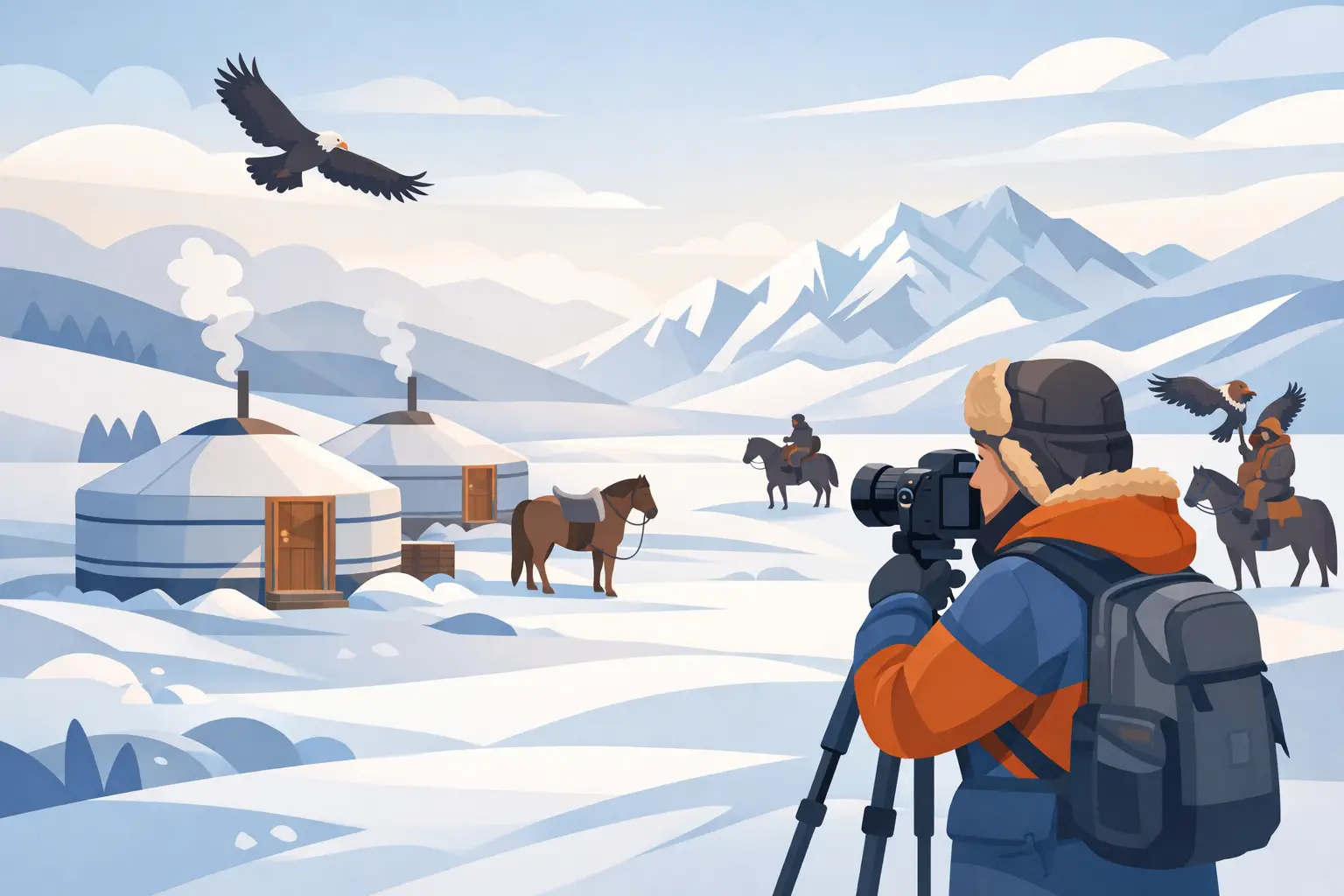
At minus 20 degrees Fahrenheit, a horse’s breath hangs in the air like smoke, the steppe turns blue before sunrise, and every small movement becomes visible against the snow. A Mongolia winter photography tour is not simply a cold-weather trip with a camera. It is an opportunity to photograph the nomadic heartland at its quietest, most elemental, and most intimate.
Winter asks more of travelers than summer, but it also gives more back. The crowds are gone, the light is low and beautifully directional, and encounters with herding families feel especially meaningful when you are welcomed into the warmth of a ger. With thoughtful planning, capable vehicles, and experienced local guides, this is a season that rewards patient photographers with images that could not be made at any other time of year.
Why Photograph Mongolia in Winter?
Mongolia’s winter landscapes are defined by space. Snow settles across wide valleys and frozen rivers, while the Altai Mountains, Khuvsgul region, and northern taiga take on a spare, graphic character. A lone rider crossing a white plain, a line of camels against pale dunes, or a ger camp beneath the Eternal Blue Sky can become a powerful composition without needing elaborate staging.
The quality of light is another reason to travel at this time. Shorter days bring long blue-hour mornings and afternoons, while the low winter sun creates texture across snow, rock, animal coats, and weathered faces. Photographers who enjoy portraiture often find that the softer natural light and slower rhythm of camp life allow more time to observe rather than rush.
Winter is also a working season for nomadic families. Livestock still need feeding and moving. Fires must be kept burning. Children travel to and from school, and families gather close to home. These are not performances for visitors. They are real daily moments, photographed best with permission, sensitivity, and enough time to let trust develop.
The Defining Subjects of a Mongolia Winter Photography Tour
A well-designed route should follow the subjects that matter most to you rather than trying to cover the entire country. Mongolia is vast, and winter travel can be slow. Fewer locations with more time in each place generally produce stronger photographs and a more grounded experience.
Nomadic life in the snow
A ger camp in winter is a study in color and contrast: painted doors, felt walls, wood smoke, horses, sheep, and bright winter clothing against an almost monochrome landscape. Inside, window light can fall gently across family life, tea preparation, handmade furnishings, and the practical rituals of staying warm.
The best images come from relationship, not intrusion. Your guide can introduce you, explain local customs, and help you understand when photography is welcome. In some homes, a wide environmental portrait may feel natural; in others, it is better to put the camera down, share a meal, and wait for the right moment.
Eagle hunters and the Altai Mountains
Western Mongolia offers one of the season’s most compelling subjects: Kazakh eagle hunters with their golden eagles. Winter can bring a dramatic setting of snow-covered valleys, fur-lined clothing, horses, and distant peaks. It is an exceptional environment for both portraiture and action photography.
There is a trade-off, however. If your main goal is to photograph the largest gathering of eagle hunters in competition, the Golden Eagle Festival and Sagsai Eagle Festival are held in autumn, not deep winter. A winter visit offers a quieter and more personal experience with individual hunting families, but not the same concentration of festival action. Both are remarkable, simply different stories.
Reindeer herders in the northern taiga
For photographers drawn to remote culture and forested winter landscapes, the Darkhad Valley and taiga communities can be deeply rewarding. Reindeer, conifer forests, frozen lakes, and the distinctive homes of Tsaatan reindeer herders create a very different visual world from the open steppe.
This is also among Mongolia’s more demanding winter journeys. Weather, snow conditions, and local logistics can affect the route. Flexibility is essential, and responsible travel matters even more. Small groups, respectful visits, and local coordination help ensure that photography does not disrupt families or animals.
Choosing the Right Winter Dates
December through February delivers the most intense cold and the strongest winter atmosphere. Temperatures vary sharply by region and altitude, but travelers should be ready for well below-freezing conditions, especially at night and in northern valleys. This period is ideal if snow, ice, frosted landscapes, and a true expedition feeling are central to your vision.
March often provides a useful balance. There can still be snow in many regions, daylight is longer, and temperatures may be less severe. It can suit photographers who want winter scenes while traveling with a little more comfort. But conditions are never identical from year to year. A route built around a specific cultural encounter, rather than a guarantee of perfect snow, is the wiser approach.
For 2026-2027, early planning is particularly valuable for private photography journeys, winter departures to northern Mongolia, and small-group expeditions. The most suitable drivers, local hosts, guides, and domestic flight arrangements are limited in winter, especially for remote routes.
How to Build a Productive Photography Itinerary
The strongest itineraries protect time for light. It is tempting to add another valley, lake, or community to the schedule, but daily long-distance driving can leave little room for dawn, dusk, or an unexpected invitation from a local family. A photography-focused journey should include unhurried stays of at least two nights where possible.
Start by deciding what you most want to photograph: eagle hunters, winter nomadic life, reindeer herders, wildlife, frozen landscapes, or a combination of these. Then choose the region that supports that story. The Altai is a natural choice for eagle culture and mountain landscapes. Northern Mongolia suits taiga, reindeer, and deep winter atmosphere. Central routes can provide accessible nomadic encounters and broad steppe scenes.
Your guide and driver are part of the photographic process. They know which roads remain practical, where a family may be open to a visit, when weather is changing, and how to communicate your interests with care. Nomadic of the Blue Sky draws on more than 15 years of local experience to shape these journeys around real seasonal conditions, not a fixed script.
Camera Gear That Works in Severe Cold
Cold does not prevent good photography, but it changes how equipment behaves. Batteries drain quickly, lenses can fog when moved between warm gers and the outside air, and bare metal becomes painful to handle. Keep your setup simple enough to use while wearing gloves.
Bring a dependable primary camera body, a backup body if photography is central to your trip, and more batteries than you expect to need. Store spare batteries in an inner pocket close to your body. A moderate zoom is practical for travel days, while a fast portrait lens is useful inside gers and for environmental portraits. A longer lens helps with horses, eagles, wildlife, and moments where distance is more respectful.
A few small habits make a difference:
- Place cameras in a sealed bag before bringing them into a warm ger, then let them warm gradually to reduce condensation.
- Use thin liner gloves beneath insulated mittens so you can adjust settings without exposing your hands for long.
- Carry a microfiber cloth and lens hood to manage snow, breath, and low-angle flare.
- Keep memory cards and a compact backup drive warm and protected from moisture.
Tripods are useful for blue-hour landscapes and night skies, though they add weight and can be awkward in snow. Whether to bring one depends on your priorities. Travelers focused on portraits, action, and daily life may prefer to remain mobile; landscape photographers will usually be glad to have it.
Photographing People With Respect
The most memorable winter photographs often involve people, and that calls for a patient approach. Ask before making close portraits. Accept a no without hesitation. Do not turn ordinary work into a posed scene unless the family is genuinely comfortable with it, and never treat children as a subject to collect.
A local guide can translate, but respect is communicated through behavior as much as language. Arrive without rushing. Participate in hospitality when invited. Show people their photographs on the back of the camera. If you travel with a small group and return home with fewer images but deeper encounters, the journey has still succeeded.
Travel With Room for the Unexpected
Winter in Mongolia is magnificent precisely because it is not fully controllable. A road may take longer after fresh snow. A clear night may become the best time for photography. A conversation over milk tea may lead to a portrait session you could never schedule in advance.
Pack for serious cold, choose a route that matches your photographic priorities, and leave enough space in the itinerary for weather and human connection. Under Mongolia’s clear winter sky, the images that stay with you are often the ones you did not set out to find.