A wrestler steps into the stadium with arms spread like a great bird in flight. Beyond the stands, children race between food stalls, families gather in bright deels, and the sound of a long song rises above the city. The Naadam Festival is Mongolia’s most celebrated cultural occasion, but it is far more than a spectacle. It is a living expression of national identity, athletic skill, family connection, and traditions shaped on the open steppe.
For travelers, Naadam can be one of the most memorable times to visit Mongolia. It can also be one of the busiest. Knowing where to go, what to expect, and how to experience the festival respectfully makes the difference between simply watching an event and understanding the spirit behind it.
What Happens at the Naadam Festival?
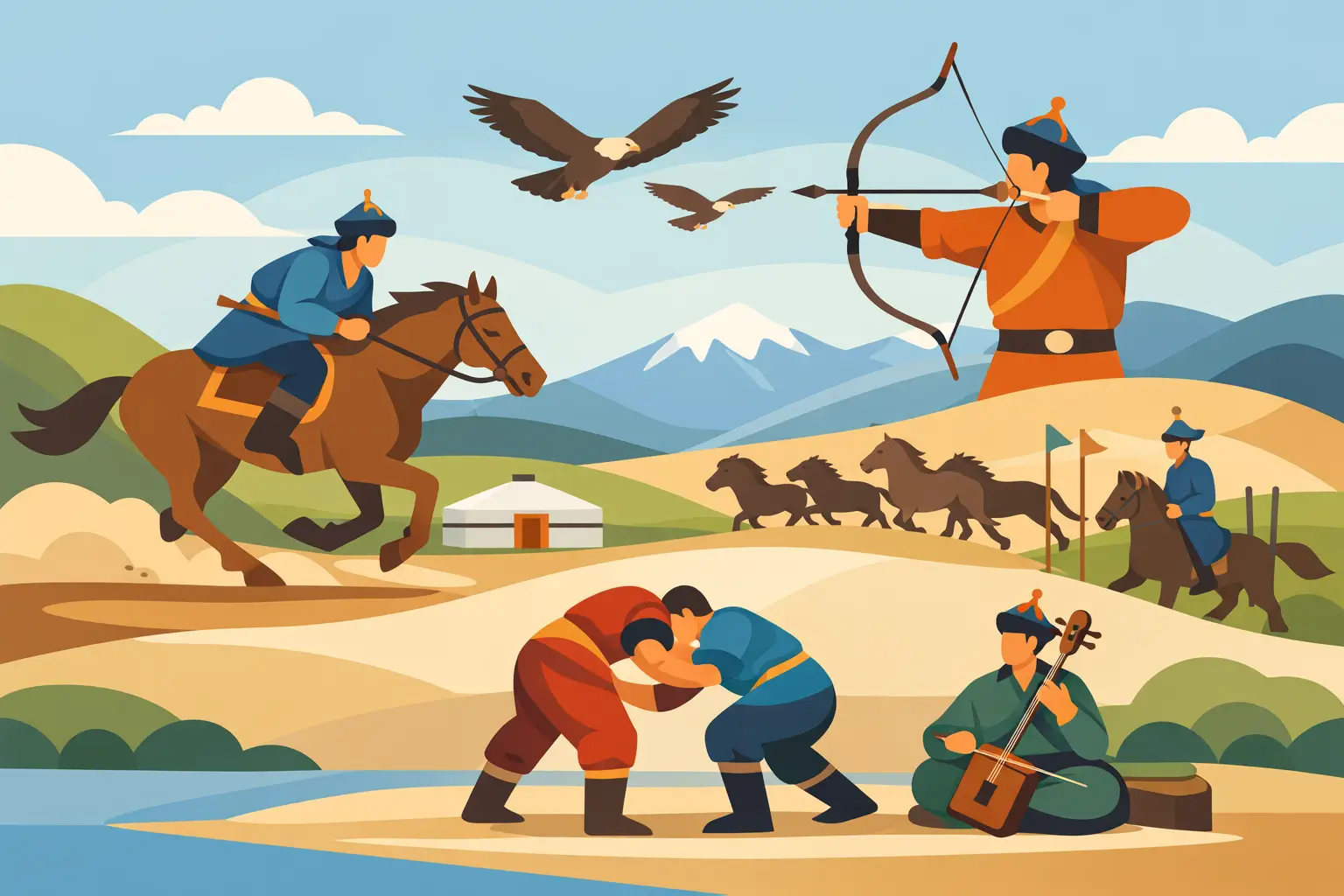
Naadam centers on the Three Manly Games: wrestling, horse racing, and archery. The name reflects historical tradition rather than a restriction on who participates today. Women compete prominently in archery, and girls race horses in many local celebrations. Each discipline carries its own rules, rituals, costumes, and social meaning.
Mongolian wrestling is the most theatrical event for first-time visitors. Wrestlers wear an open-front jacket, briefs, and traditional boots, then perform the eagle dance before and after bouts. There are no weight classes. A lighter, faster competitor may meet a much larger opponent, and a single touch of the ground with anything other than hands or feet ends the match. The contest rewards balance, timing, and tactical patience as much as strength.
Archery has a quieter intensity. Competitors stand in lines, releasing arrows toward rows of small leather targets while singers and judges call out each successful shot. It is a disciplined, communal event rather than a fast-moving arena sport, and it rewards slowing down to notice the rhythm of the participants and spectators.
Horse racing is perhaps the clearest link to Mongolia’s nomadic heartland. These are long-distance races across open country, not laps around a formal track. Young riders, often children, guide horses over demanding terrain. Winning horses are celebrated, but every horse that completes the course is honored. The race reflects the deep partnership between Mongolian people and horses, developed over centuries of life on the grasslands.
Ulaanbaatar or the Countryside?
The national Naadam in Ulaanbaatar is the largest and most accessible version of the festival. It brings together formal opening ceremonies, major wrestling rounds, archery, ankle-bone shooting, cultural performances, and large crowds. For travelers with limited time, it offers a concentrated introduction to Naadam and convenient access to hotels, restaurants, and transport.
Its scale comes with trade-offs. Stadium events can be crowded, traffic is heavier, and the horse races take place outside the city, requiring advance transport planning. The opening ceremony is visually impressive, but it is also the moment when seating and timing matter most. Travelers who want to attend should arrange tickets and logistics early, especially when combining Naadam with a summer Mongolia journey.
Countryside Naadam celebrations are smaller, less polished, and often more intimate. A provincial or community festival may have fewer visitors, simpler facilities, and a more relaxed pace. What it offers instead is proximity: families picnicking on the grass, local wrestlers greeted by name, horses warming up in nearby fields, and a stronger sense that the day belongs to the community rather than an audience.
There is no single best choice. Ulaanbaatar suits travelers seeking the grand national event and reliable logistics. A local Naadam is often better for those who value photography, cultural context, and time in rural Mongolia. A well-designed itinerary can combine both, beginning with the national celebration and continuing into the steppe, the Gobi, or northern lake country after the crowds have eased.
Planning a Naadam Festival Journey
Naadam falls in the heart of Mongolia’s short summer travel season, usually around mid-July. Days can be pleasantly warm, but weather remains changeable. Strong sun, dry wind, sudden rain, and cool evenings are all possible, particularly in the open countryside. Bring layers, a rain shell, sun protection, comfortable walking shoes, and a small day bag for long festival days.
Accommodation in Ulaanbaatar becomes more limited around the festival period, while domestic flights and suitable vehicles are in high demand. This matters even more for travelers hoping to continue to remote regions after Naadam. Mongolia is vast, road journeys can be long, and some of the most rewarding areas have few accommodations beyond ger camps or stays hosted by nomadic families. Booking early allows more flexibility in route design and comfort level.
Festival travel also requires realistic expectations about schedules. Horse races may start early, roads can be busy, and events may not run with the minute-by-minute precision expected at a major sporting venue elsewhere. A local guide is valuable not just for translation, but for reading the day: knowing when to leave for the races, where to stand for a better view, and when a quieter local event may offer a richer experience than a crowded headline attraction.
At Nomadic of the Blue Sky, we recommend building extra breathing room into festival itineraries. The strongest Mongolia journeys leave space for changing weather, road conditions, and the unexpected moments that make travel here memorable.
Customs That Help You Feel Welcome
Naadam is festive and welcoming, but it is not a costume party. Wearing a deel, Mongolia’s traditional robe, can be a meaningful experience when arranged thoughtfully, yet visitors do not need traditional clothing to participate respectfully. Clean, practical clothes are entirely appropriate.
Ask before photographing individuals closely, especially children, elders, wrestlers preparing for competition, and families gathered for private meals. A friendly gesture and a few words through a guide go a long way. When photographing horse races, avoid stepping into the course or blocking participants. The finish area can be energetic and chaotic, so follow local direction closely.
Food is part of the occasion. You may see khuushuur, fried meat pastries, airag made from fermented mare’s milk, dairy products, and shared picnic dishes. Accepting a small offering is often a warm sign of respect, although travelers with dietary restrictions should explain them clearly through a guide. If offered airag, it is perfectly acceptable to take a small sip or politely decline.
The Best Naadam Festival Moments for Photographers
Naadam offers far more than stadium action. The strongest images often come from the edges of the event: a young rider adjusting a cap before a race, a grandmother watching wrestling from the shade, dust rising beneath returning horses, or the bright colors of deels against a wide summer sky.
For horse racing, a longer lens is useful, but dust protection for cameras is equally important. For wrestling and archery, a moderate telephoto lens helps capture expressions and ritual without crowding competitors. Keep equipment simple and mobile. Festival grounds involve walking, waiting, and quickly changing light.
Photography should never take priority over safety or courtesy. The most rewarding opportunities usually appear after a photographer has spent time observing, listening, and allowing the atmosphere to unfold. In rural settings, a guide who knows the community can help create respectful introductions rather than treating local life as a backdrop.
Why Naadam Stays With Travelers
Naadam is often described as Mongolia’s greatest festival, but its real power lies in how naturally the past and present sit together. Traditional sports fill the day, while smartphones record the races. Families travel in from the countryside, city residents dress in their finest deels, and old songs are heard beside modern traffic. Nothing feels preserved behind glass.
For travelers who come with patience, curiosity, and a willingness to look beyond the headline events, the festival offers an unusually direct connection to Mongolia’s culture. Let the wrestling stadium be only the beginning. Follow the horses toward the open land, share the shade with local families, and leave room for the smaller moments beneath the Eternal Blue Sky.