Mongolia Travel Blog
Small Group Versus Private Mongolia Tours
Compare small group versus private Mongolia travel for flexibility, comfort, timing, photography, festivals, and meaningful local encounters in Mongolia.
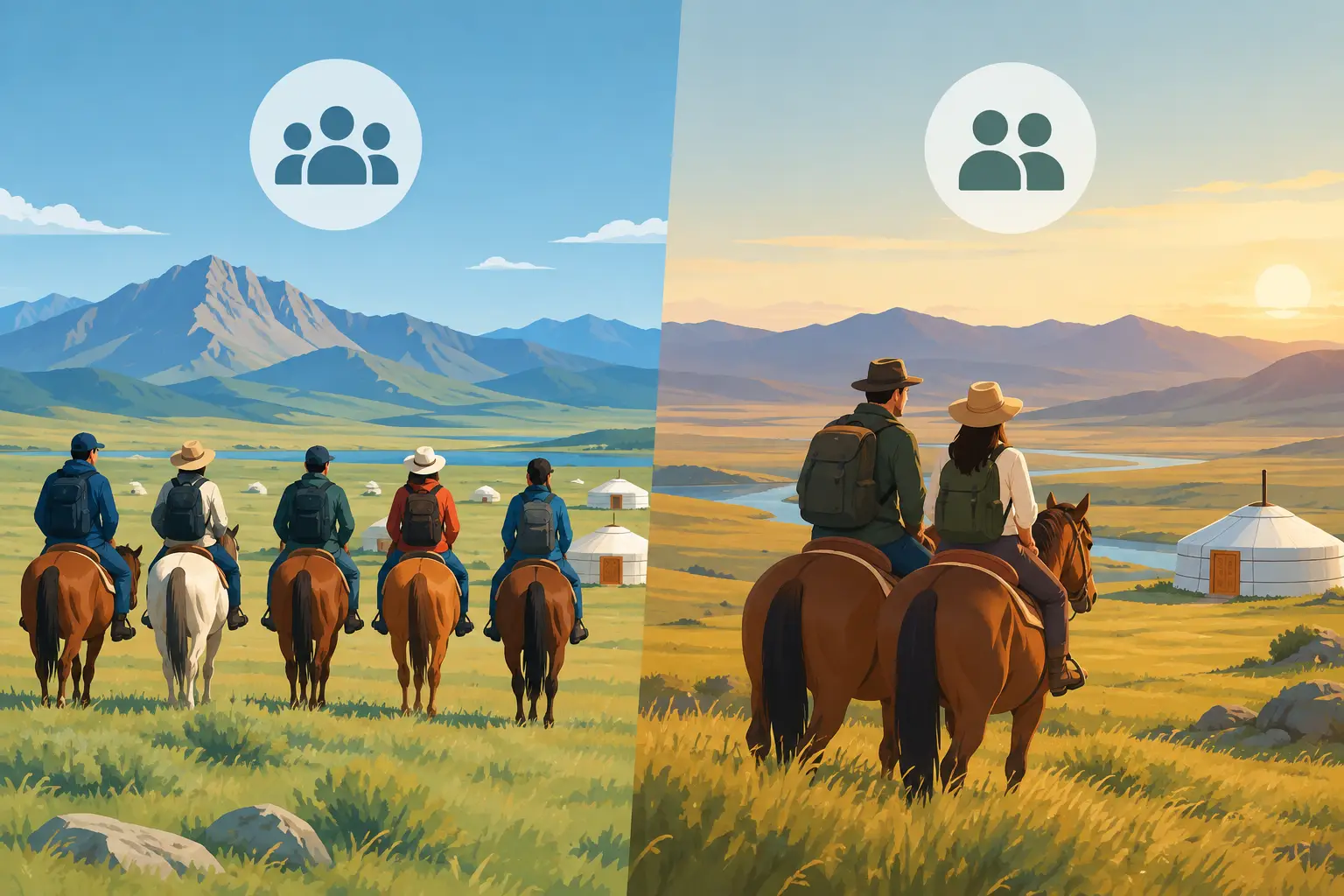
A Mongolian journey can begin with a smooth highway outside Ulaanbaatar and, a few hours later, find you crossing open steppe with no road in sight. That reality shapes the choice between small group versus private Mongolia travel more than almost anything else. Both can bring you close to the nomadic heartland, sacred mountains, desert silence, and generous local hospitality. The better choice depends on how you want to move through a country where weather, long distances, and genuine encounters all influence the day.
Small Group Versus Private Mongolia: The Real Difference
A small-group journey follows a thoughtfully planned shared route with a limited number of travelers, a Mongolian guide, driver, and a clear rhythm for each day. It suits people who want the reassurance of a planned expedition while sharing the experience with others. On a Gobi route, a Naadam Festival departure, or an Altai adventure, the group often makes the remote logistics feel more approachable without turning the journey into a rushed sightseeing schedule.
A private journey is designed around your party. The route, pace, accommodation style, interests, and time at key locations can be adapted before departure and, within the limits of weather and road conditions, adjusted on the road. This can be especially valuable for couples, families, photographers, horse riders, and travelers with a very particular vision of Mongolia.
The difference is not simply privacy. It is about where you place flexibility. In a small group, travelers agree to a shared daily framework. In a private journey, that framework is built around you.
Mongolia rewards realistic pacing
Mongolia is vast, and travel times are often defined by terrain rather than kilometers. Outside the main paved corridors, drivers may follow tracks across grassland, gravel plains, sandy valleys, or mountain passes. Rain can soften a track, wind can slow travel in the Gobi, and a river crossing may look different after a storm.
A good small-group itinerary allows for this. It should not promise a string of distant highlights with little time to absorb any of them. The advantage is that the route has already been tested for the season and group size, with suitable overnight stops and realistic driving days.
A private trip gives you more control over the pace. You might choose an extra night beside Khuvsgul Lake, a slower approach to the Altai Mountains, or a shorter driving day for children. But private does not mean that every request is possible. Mongolia’s remote regions have limited lodging, changing weather, and practical fuel and vehicle considerations. The best tailor-made plans use flexibility wisely rather than trying to defeat geography.
When a Small-Group Journey Is the Better Fit
Small-group travel is often an excellent choice for solo travelers, first-time visitors to Mongolia, and couples who enjoy conversation as part of the journey. There is a particular pleasure in sharing the first sight of the Flaming Cliffs at sunset, a bowl of salty milk tea in a family ger, or the intensity of a wrestling match at Naadam with people who understand why the moment matters.
It also offers a balanced way to experience remote travel. Travelers share the vehicle, guide, campfire conversations, and occasional changing plans, while the local team manages the details that can be difficult to arrange independently. A small group can be especially appealing for set-date festival journeys, where transport, camps, and local timing must work together.
The trade-off is clear: your preferences matter, but they are balanced with the group’s. If one traveler wants to spend an extra hour photographing a herd of horses while another is ready to continue, the guide must keep the day moving. Meal timing, wake-up times, and activity choices are also shared.
That does not make the experience less personal. With a well-sized group and an experienced Mongolian guide, there is still room for meaningful conversation with local hosts and time away from the vehicle. It simply requires a spirit of cooperation.
Shared travel works best with a shared mindset
Choose a small group if you value a set departure, appreciate a social atmosphere, and are comfortable with a route designed for several people. It is also a sensible option when a specialist itinerary, such as a festival or seasonal expedition, has a fixed sequence that would be difficult to improve through customization.
Before booking, look beyond the headline destinations. Ask about the maximum group size, vehicle seating, average driving days, accommodation, and whether there is free time at major locations. These details shape comfort far more than a polished itinerary map.
When Private Mongolia Travel Makes More Sense
Private travel comes into its own when your interests need more than a standard itinerary can provide. A photographer may want to work in the soft light before breakfast and stay out after sunset. A family may need a gentler rhythm, private space at night, or activities that hold different ages’ attention. Horse riders may want the route to focus on time in the saddle rather than covering ground by vehicle.
It is also the stronger choice for travelers who want to explore one area in depth. Rather than combining the Gobi, central Mongolia, and the north in a short period, a private itinerary can linger. You may spend more time among the granite formations of the Gobi, plan a quieter route through central steppe, or allow weather days in western Mongolia where mountain conditions can change quickly.
Private journeys can use a broader range of accommodations, from well-run ger camps to more comfortable lodges where available, alongside carefully arranged stays near nomadic communities. Yet expectations should remain grounded. In remote areas, a guest ger may have simple facilities, and showers, electricity, and mobile signal can be limited or intermittent. The privilege is not polished uniformity. It is waking to livestock moving across the valley and seeing the Eternal Blue Sky before the day begins.
Privacy should not mean isolation from culture
A private itinerary can create more time for respectful cultural exchange, but it should never treat nomadic households as a private attraction. Families have work, children, animals, and seasonal responsibilities. A good guide helps make introductions appropriate, translates conversations, and ensures visits fit local circumstances.
Simple etiquette matters. Accept food or tea graciously when offered, use your right hand or both hands when receiving something, ask before photographing people or inside a ger, and follow your guide’s lead around family spaces and religious sites. The most memorable encounters usually come from patience and curiosity, not a tightly scheduled visit.
Cost, Comfort, and the Value of Control
A small group usually spreads the cost of vehicles, guides, fuel, and support among travelers. This can make ambitious routes more accessible while retaining the safety and local knowledge needed for remote travel.
Private travel generally costs more per person because the vehicle, driver, guide, and route planning are dedicated to your party. For a family or a group of friends, the difference per traveler may be less dramatic than for a solo traveler or couple. The value lies in control over the route, timing, rooming needs, food preferences, and the ability to add rest days where they matter most.
Comfort in Mongolia also deserves a practical definition. A private vehicle gives your party more personal space, but it cannot smooth every rough track. A higher accommodation standard can improve rest, but it may require detours or limit how deep into a remote region you travel. The strongest journeys decide where comfort is essential and where a little simplicity is part of reaching the landscape.
Festivals, Photography, and Seasonal Decisions
For Naadam, Golden Eagle Festival, and Sagsai Eagle Festival travel, small groups work very well when you want dependable logistics around busy event days. A shared departure can also bring together travelers who are equally interested in culture and photography.
Private travel is preferable when photography is the central purpose. It allows for early starts, patient waiting, alternate viewpoints, and a route built around light and subjects rather than a standard daily timetable. Still, festivals are live events, not studio productions. Access, weather, participant movements, and local schedules can change, so a skilled guide and realistic expectations are essential.
Winter adds another layer. The cold can be severe, daylight is shorter, and transport plans need careful preparation. A private winter journey may suit travelers who want a specific focus and are prepared for a more deliberate pace. A small-group winter departure offers companionship and a shared expedition spirit, provided everyone is ready for the conditions.
Make the Choice Before You Build the Route
Start with the experience you want to protect. If it is meeting fellow travelers, joining a proven seasonal route, and sharing the practical realities of an overland adventure, choose a small group. If it is time, privacy, a specialized interest, or a route shaped around your own pace, build a private journey.
Then be honest about your tolerance for long drives, simple facilities, and changing plans. Mongolia is at its best when there is room in the itinerary for a stop that was not on the map: a herder bringing in horses at dusk, a sudden band of light across the steppe, or an invitation to sit down for tea. Leave space for that, and the journey will feel like Mongolia rather than a checklist.
Plan Your Mongolia Journey
Explore locally operated tours or ask our Mongolia team to tailor a private journey.