Mongolia Travel Blog
10 Best Gobi Desert Experiences Worth the Distance
Plan the best Gobi Desert experiences, from singing dunes and dinosaur cliffs to nomadic ger stays, with practical advice on routes, seasons, and comfort.
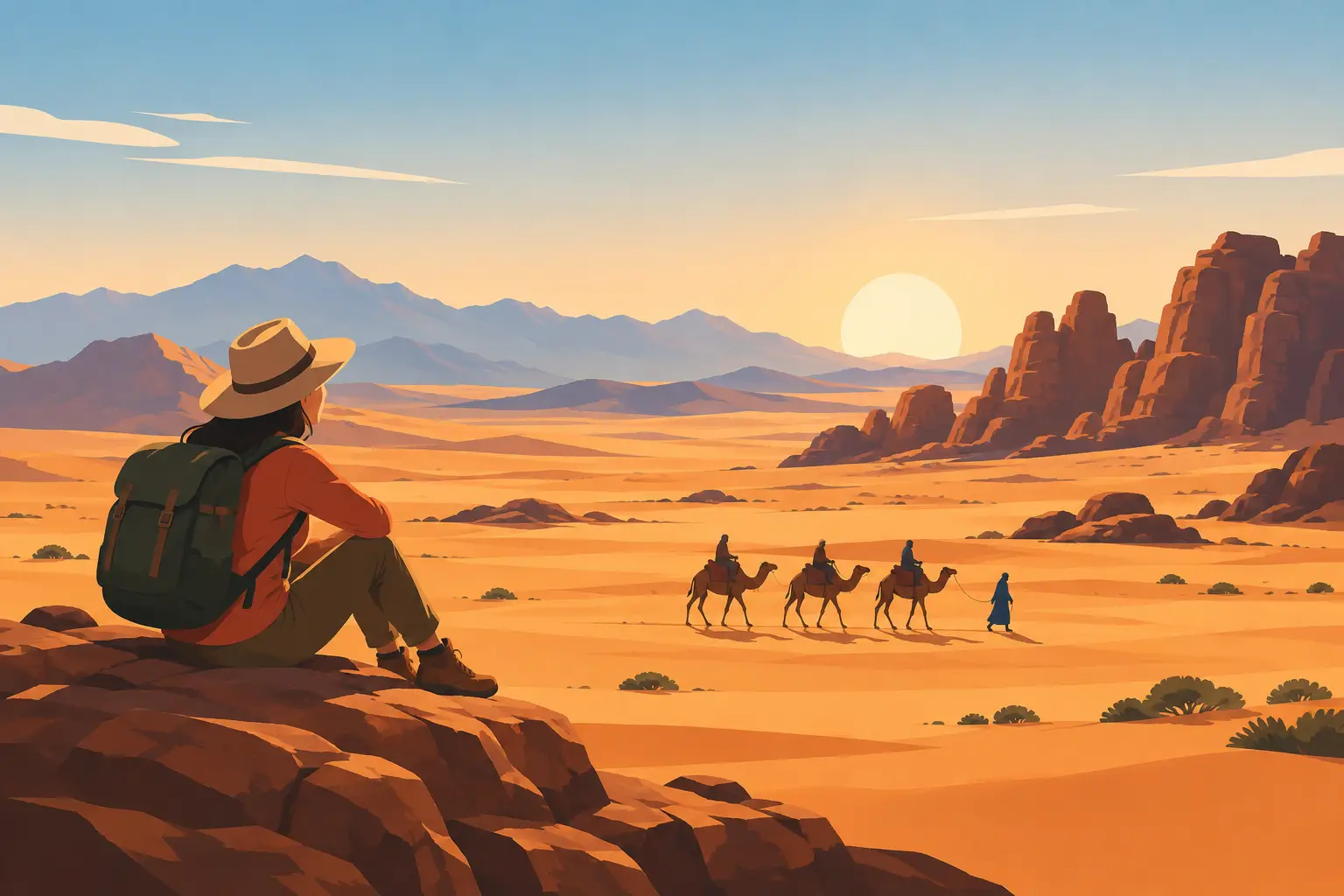
The Gobi does not reveal itself through one dramatic view from a roadside stop. The best Gobi Desert experiences unfold over several days: a camel caravan disappearing into the dunes, a family offering salty milk tea inside a warm ger, cliffs where dinosaur fossils still emerge from the earth, and stars sharp enough to make the night feel almost close.
This is a vast region of southern Mongolia, not a single landscape. It combines desert steppe, red rock formations, deep canyons, gravel plains, mountain valleys, and sand dunes that can seem to run to the horizon. Distances are substantial and road conditions vary, which is exactly why a well-paced itinerary matters more here than trying to see everything quickly.
1. Climb the Singing Dunes at Khongoryn Els
Khongoryn Els is the Gobi image most travelers carry home: long, pale-gold dunes rising beside the dark line of the Altai Mountains. Some dunes reach impressive heights, and climbing them is demanding, particularly in midday heat. Start early or go late in the afternoon, when the sand is cooler, the light is gentler, and the surrounding valley takes on deep color.
The dunes are called the Singing Dunes because moving sand can create a low, resonant sound under the right conditions. The phenomenon is never guaranteed, but the climb itself is memorable. From the crest, look west across the desert and east toward the green ribbon of the Khongor River, where camel-herding families often make their seasonal camps.
Camel riding is available near the dunes and can be a fitting way to understand the scale of the landscape. It is best treated as a short cultural and scenic experience rather than a test of endurance. A two-humped Bactrian camel is well adapted to this environment, but the ride can feel unfamiliar for first-time riders.
2. Stay With a Nomadic Family
A night near a nomadic family is often more meaningful than another scenic stop. In the Gobi, herding households may raise camels, goats, sheep, horses, and cattle, moving seasonally in response to pasture and weather. Their ger is both home and a practical structure for a life lived in an exposed landscape.
Guests should arrive with curiosity and patience, not the expectation of a staged performance. Daily life continues: animals need tending, meals need preparing, and family members may be busy with work. Your guide can help with introductions and translation, while ensuring the visit is respectful and welcome.
Accepting tea or food when offered is polite. Ask before photographing people, children, or the interior of a ger, and avoid stepping over personal belongings or sitting with your feet pointed toward the household altar. Small gestures of courtesy matter greatly in a place where hospitality is offered generously.
3. Walk Through Yolyn Am in Gobi Gurvansaikhan National Park
Yolyn Am, often called Eagle Valley, surprises travelers who expect only sand and open desert. This narrow mountain gorge lies in the Gurvan Saikhan range, where sheer rock walls create shade and cooler air. Depending on the season and the winter snowpack, ice can linger in sheltered areas well into warmer months.
The valley is a good place to stretch your legs after long drives and to watch for wildlife. Be alert for ibex on distant slopes, birds of prey overhead, and smaller animals moving between rocks. A short walk offers the most accessible experience, while conditions and time may allow longer exploration deeper into the gorge.
Bring a warm layer even in summer. Gobi weather changes quickly, and windy valleys can feel much cooler than the surrounding plains.
4. Stand at the Flaming Cliffs at Sunset
Bayanzag, widely known as the Flaming Cliffs, earns its name in the late afternoon, when its sandstone escarpments glow orange and red beneath the Eternal Blue Sky. The site is internationally significant for dinosaur fossil discoveries, including early finds of dinosaur eggs, but its power is also visual. Wind has cut the cliffs into layers, gullies, and natural terraces over millions of years.
Visit close to sunset, but leave enough time to walk beyond the parking area. The colors deepen as the sun lowers, while the open desert beyond the cliffs turns soft and blue. Photographers should bring both a wide lens for the full escarpment and a longer lens for compressed layers of rock and small details in the landscape.
This is a protected fossil area, not a place to collect souvenirs. Leave stones, fossils, and fragments where they are so the site remains intact for scientific study and future visitors.
5. Find the White Stupa of Tsagaan Suvarga
Tsagaan Suvarga, or White Stupa, is a striking escarpment shaped by erosion into a series of pale cliffs. Its name comes from the forms that resemble a line of stupas, but the colors are what many travelers remember: white, ocher, rust, and pink bands shifting with the changing light.
It is especially rewarding for travelers who enjoy landscape photography and quieter places. Unlike the dunes, there is no single prescribed activity here. Walk carefully along designated viewpoints, watch the shadows move across the formations, and allow time for the desert silence to settle in.
Wind can be strong near the edge, and loose ground deserves respect. A local driver and guide are valuable not only for navigation but also for choosing safe approaches and the best time of day.
6. Watch the Gobi Change After Rain
Rain is never something to plan a desert journey around, yet when it arrives it transforms the Gobi. Dry channels can carry water, dust settles from the air, and the grasses and low plants appear brighter almost immediately. The desert is not empty - it is a finely balanced environment shaped by scarcity, wind, and seasonal change.
A rainstorm can also disrupt driving. Unpaved tracks may become muddy, and a route that looked straightforward in the morning may require a detour later that day. This is one reason flexible timing, reliable vehicles, and drivers experienced with local terrain are central to a successful Gobi journey.
7. Sleep Under a Desert Sky
Away from city lights, the Gobi offers exceptional night skies. On clear nights, the Milky Way can be visible across the entire sky, and the silence between gusts of wind is profound. Most travelers sleep in tourist ger camps, which provide beds, meals, and shared or private facilities depending on the camp and itinerary. Some routes also include a family ger stay.
A ger camp is usually the sensible balance between remoteness and comfort. Facilities are simpler than a city hotel, and electricity or hot water may be limited at certain times, but the setting is the reward. For private travelers, it is often possible to prioritize camps with more comfortable arrangements while keeping the journey close to the landscape.
8. See the Desert Through a Photographer’s Lens
The Gobi rewards patience more than rushing. Its best images often come before breakfast, near sunset, or during the blue hour when a ger’s smoke rises against a darkening sky. Wind patterns in sand, camel silhouettes, weathered hands preparing dairy products, and distant mountains all tell a more complete story than a single landmark photograph.
Always ask before making portraits, particularly during family visits. If people agree, take time to speak first through your guide. The resulting photographs tend to be more natural, and the encounter remains a human one rather than a transaction.
9. Travel the Long Roads With Realistic Expectations
The road itself is part of the Gobi experience. Even with domestic flights reducing travel time on some itineraries, overland days can be long. Much of the route may follow paved highway, but reaching major sites often requires travel on dirt tracks across open country. Dust, corrugations, and occasional delays are normal.
The best itineraries do not pack every day with activities. They allow for a proper lunch stop, time to walk at a scenic location, changes in weather, and the simple pleasure of watching Mongolia’s vastness pass beyond the window. If comfort is a priority, consider a tailor-made journey with a private vehicle, realistic daily driving distances, and carefully selected ger camps.
10. Choose the Season That Matches Your Priorities
Late spring through early fall is the main period for Gobi travel, though conditions differ significantly. Spring can be cool, windy, and clear, with fewer travelers and dramatic skies. Summer brings warmer days and greener pasture in some valleys, but also stronger sun and occasional thunderstorms. Early fall often offers crisp air, golden light, and comfortable daytime temperatures, while nights can turn cold.
July and August are not automatically the best choice for every traveler. Families may prefer warmer weather, while photographers and travelers who enjoy cooler conditions may favor late May, June, or September. Whatever the month, pack layers: a sun hat, sunscreen, sunglasses, a windproof outer layer, warm clothing for evenings, and closed shoes for walking on sand and rock.
The Gobi is best approached not as a checklist of famous stops but as a journey with room for the unexpected. Give it enough days, travel with people who understand the terrain and its communities, and let the desert set a slower pace. That is when its vast distances begin to feel less like an obstacle and more like the point.
Plan Your Mongolia Journey
Explore locally operated tours or ask our Mongolia team to tailor a private journey.