Mongolia Travel Blog
Gobi Tours: How to Choose the Right Journey
Plan Gobi tours with practical advice on routes, seasons, camps, road conditions, nomadic encounters, photography, and choosing the right pace in Mongolia.
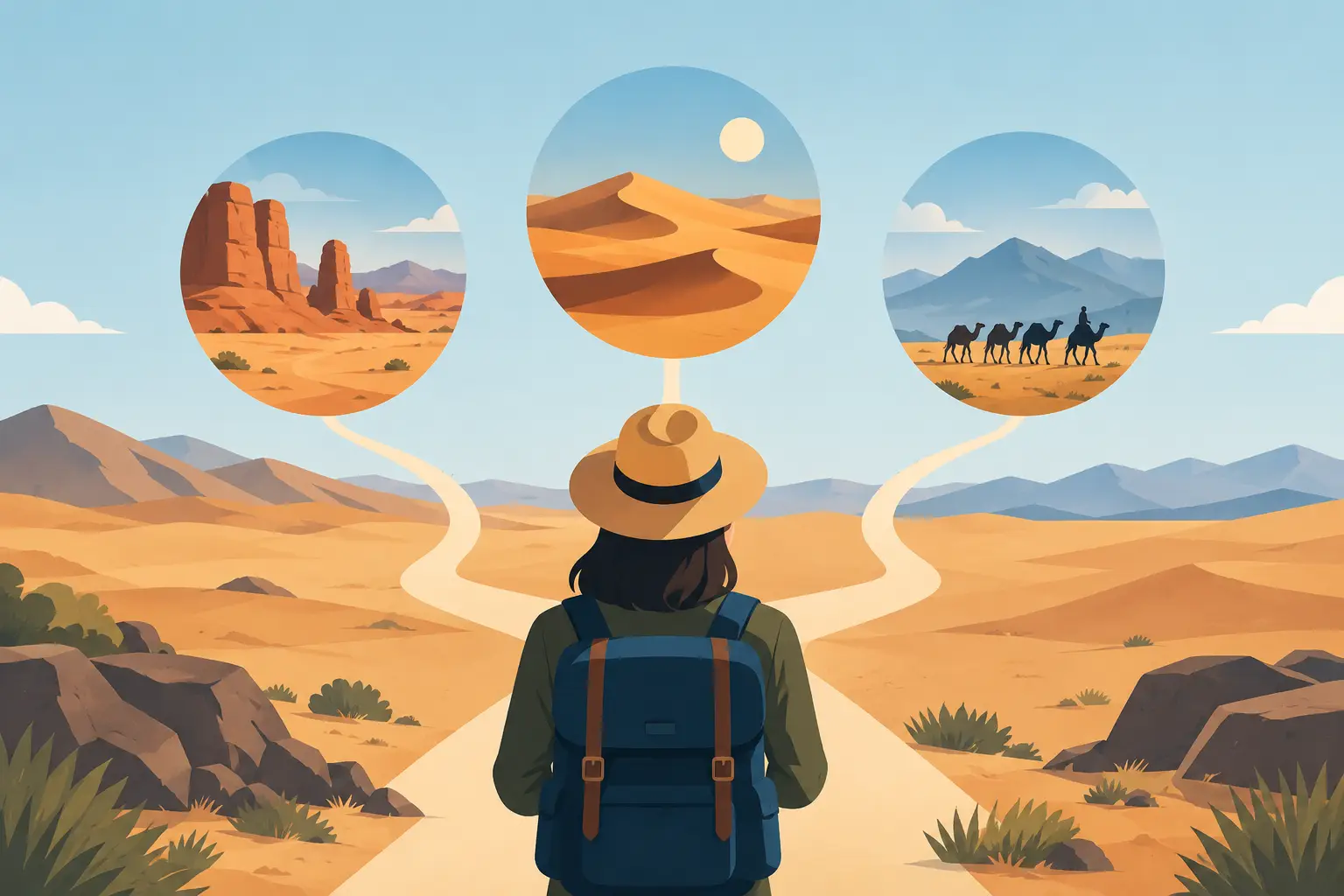
The Gobi is not one vast, empty desert crossed in a day. It is a shifting world of grass steppe, red cliffs, fossil beds, soaring dunes, dry river valleys, and small settlements separated by long distances. The best Gobi tours give those distances room to breathe, combining the headline landscapes with time for the quieter moments: tea in a ger, a camel herd moving across the sand, or the startling silence after sunset under Mongolia's Eternal Blue Sky.
For many travelers, the challenge is not deciding whether to visit the Gobi but choosing the right route, season, and travel style. A well-planned journey makes the region comfortably accessible while preserving the sense that you have reached Mongolia's nomadic heartland.
What makes Gobi tours different
The Gobi Desert covers a vast area of southern Mongolia, and its landscapes vary dramatically. A journey may begin among the ochre cliffs of Bayanzag, continue to the singing dunes of Khongoryn Els, and cross open country toward Yolyn Am in the Gurvan Saikhan Mountains. These are classic highlights for good reason, but they are far apart. Getting between them is part of the experience.
Road conditions range from paved highway near larger towns to wide, unmarked tracks across open desert. There is often no single road - drivers choose a sensible line according to weather, ground conditions, and local knowledge. This is why an experienced driver and guide matter as much as the itinerary itself. The Gobi rewards flexibility, particularly after rain or during periods of strong wind.
Travel here is also more than scenery. Families continue to herd camels, goats, sheep, and horses across the region, adapting their seasonal movements to pasture and water. A respectful visit to a nomadic household can bring a journey into focus, but it should never feel staged or rushed. Tea, dried curds, and conversation through a guide are often simple, generous introductions to daily life.
The classic Gobi Desert route
For a first visit, allow enough time to connect the Gobi's major landscapes without turning every day into a long transfer. A route of roughly one week is often a sensible starting point, depending on flights, pace, and whether you travel privately or with a small group.
Yolyn Am and the Gurvan Saikhan Mountains
Yolyn Am, commonly known as Eagle Valley, offers a striking contrast to the usual idea of desert. Its narrow gorge cuts through the Gobi Gurvan Saikhan National Park, where steep rock walls can hold cooler air than the surrounding plains. Walking conditions and ice vary by season, but the valley is valued for its mountain scenery and chances to spot wildlife such as ibex, marmots, and raptors.
This is a good first stop because it introduces the Gobi's scale gradually. It also sets up one of the region's enduring surprises: desert travel in Mongolia is rarely only about sand.
Bayanzag and its ancient landscape
Bayanzag, or the Flaming Cliffs, is most memorable late in the day, when its deep red sandstone catches the low sun. The area is internationally known for dinosaur fossils, including important discoveries of dinosaur eggs. Travelers should treat the cliffs as a protected landscape, not a place to search for or remove fossils.
Photographers will find strong color and texture here, especially in the hour before sunset. A good guide can help time the visit around changing light and avoid the temptation to rush onward as soon as the photographs are taken.
Khongoryn Els and the Singing Dunes
Khongoryn Els are among Mongolia's most impressive dune systems, rising above the surrounding desert steppe. Climbing the dunes is demanding - soft sand, heat, and wind make the ascent slower than it looks - but the views across the broad Khongor River valley are exceptional.
The dunes are often called singing because moving sand can create a low, resonant sound. Whether you hear it depends on conditions. It is better to approach this as a possibility than a promise, since wind and sand behavior change constantly.
A nearby camel-herding family visit can add cultural context to this stop. Bactrian camels are deeply suited to the Gobi environment, and a short camel ride may be offered in some areas. It is an enjoyable experience for many travelers, though it should be viewed as an optional activity rather than the main purpose of the journey.
Choosing the best season for the Gobi
Late spring through early fall is the usual travel window, but each period brings a different character. June through August offers warmer conditions and fuller activity at ger camps, while July can pair naturally with a wider Mongolia itinerary that includes the Naadam Festival. It is also the busiest period for domestic travel, so early planning is wise.
September is often excellent for clear light, cooler walking temperatures, and photography. The land begins to take on autumn tones, and nights can be noticeably cold. May and early June bring fresh green across parts of the steppe after favorable moisture, though temperatures and winds can still be variable.
The Gobi is not uniformly hot. Summer days can be very warm, but nights may become chilly, especially after a windy day or at higher elevations. Spring and autumn require layers, a warm jacket, and a hat that stays secure in gusts. Winter journeys are possible with specialist planning, but the cold, shortened daylight, and limited seasonal services make them better suited to travelers who specifically want a winter expedition.
Accommodation, comfort, and realistic expectations
Most Gobi journeys use tourist ger camps: circular felt dwellings set in scenic locations, usually with beds, a stove, and shared or separate service facilities depending on the camp. Standards vary by location and season. The appeal is not hotel-style uniformity but the rare chance to sleep close to the landscape, wake to camel bells, and step outside beneath an immense sky.
Private journeys can be designed with more spacious pacing, upgraded camp arrangements where available, and vehicle support tailored to a couple, family, or small group. Small-group departures can offer companionship and straightforward logistics. Neither is automatically better. The right choice depends on how much flexibility you want, your comfort preferences, and whether your interests lean toward photography, walking, culture, or a broader Mongolia itinerary.
Expect long drives on some days. Bring a refillable water bottle, sun protection, lip balm, personal medication, and a small daypack with layers readily available. Mobile service can be intermittent outside settlements. This is one of the Gobi's great gifts, but it means travelers should be prepared to be present rather than constantly connected.
How to travel respectfully in the nomadic heartland
Nomadic hospitality is generous, and courtesy goes a long way. Ask before photographing people, children, homes, or animals. Accepting a small offering of tea or food is generally a warm gesture, though a guide can help if you have dietary needs. Do not walk into a ger without invitation, and avoid handling household items or herding equipment unless invited.
The desert environment also needs care. Stay on established tracks whenever possible, take all waste with you, and avoid disturbing wildlife. Water is scarce in many areas, so use it thoughtfully. Responsible travel is not separate from the experience - it helps ensure that the places and communities travelers come to see remain viable for the people who live there.
Planning a Gobi journey around your interests
A standard route works well for many first-time visitors, but the Gobi is particularly rewarding when shaped around a clear interest. Photographers may want more time at Bayanzag and Khongoryn Els for dawn and dusk light. Families may prefer shorter driving days and camps with room to settle in. Travelers interested in culture may choose a route with more carefully paced nomadic encounters. Those combining the Gobi with central Mongolia, Khuvsgul Lake, or western Mongolia should allow realistic transfer time rather than trying to cover the country in one fast loop.
From our experience designing Mongolia journeys, the strongest itineraries do not try to see every landmark. They balance a few unforgettable places with time to absorb the road, the weather, and the hospitality that make the Gobi feel so different from anywhere else.
Choose a journey with a pace you can enjoy, not merely endure. When the dunes turn gold at evening and the last vehicle track disappears behind you, an extra unhurried hour in the Gobi can become the part you remember most.
Plan Your Mongolia Journey
Explore locally operated tours or ask our Mongolia team to tailor a private journey.